
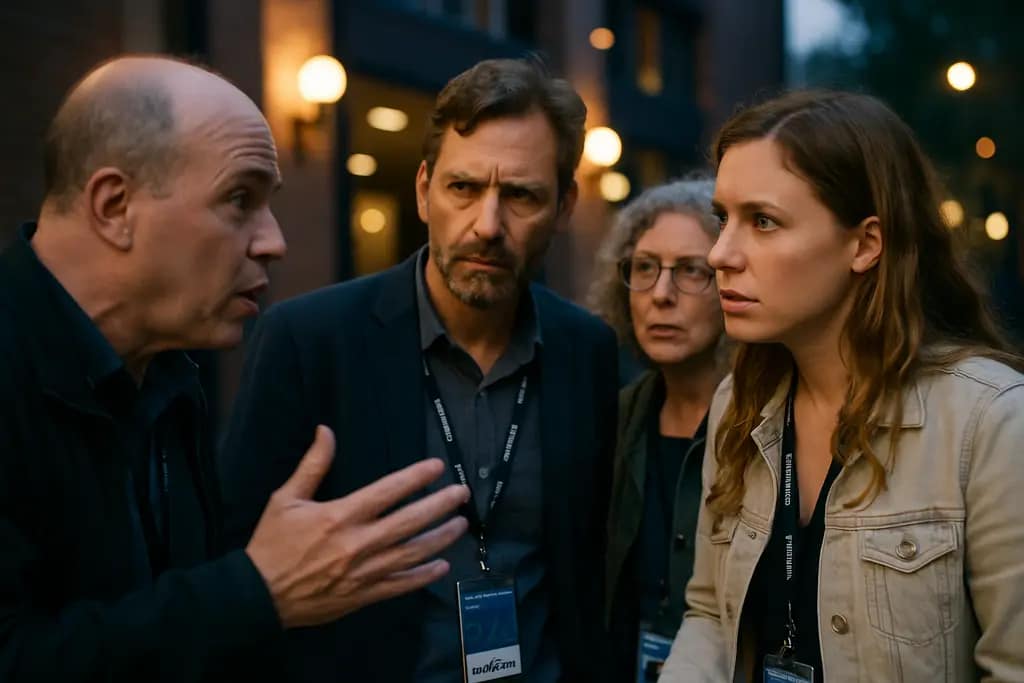
TIFF AI backlash became one of the clearest audience-engagement signals from the 2026 Toronto International Film Festival after a September 15, 2026 Q&A for Ink. Confirmed reporting said several audience members jeered director Danny Boyle over the film’s use of AI to animate old photographs and add mice in montage scenes, with one demand reported as “never do that shit again” CityNews reported. The incident did not prove that all TIFF attendees rejected AI. It did show that some festival audiences now treat AI disclosure as part of the viewing contract, not a side issue.
Market-analysis: the reaction mattered because festivals depend on a different trust model than mass entertainment platforms. A ticket buyer at a major festival often arrives expecting access to artist intent, production context, and live dialogue. If attendees later learn that AI tools were used without clear framing, the emotional response can shift from critique of a technique to a feeling of being misled. That is a cultural issue as much as a production issue.
Why TIFF AI Backlash Centered On Disclosure
Confirmed Trigger: The Ink Q&A
Confirmed: the flashpoint was not simply that Ink used AI. The stronger audience response came during a live setting where the director was present and viewers expected direct answers. Another report said Boyle told the TIFF audience that Ink used “only a small amount of AI” Gossip Herald reported. That phrase is useful for understanding the gap between creator framing and audience concern. A filmmaker may describe AI use by volume. A viewer may judge it by principle, visibility, labor implications, or whether the information was available before the screening.
Reviewed context: audience members at festivals do not all approach AI with the same assumptions. Some may accept AI as a post-production aid if it is limited and disclosed. Others may object to generative or synthetic elements regardless of scope. The September 15 exchange suggested that “small amount” is not always a reassuring answer. For some attendees, even limited AI use can feel significant if it touches archival imagery, animation, or emotional texture.
Market-Analysis: Why Stickers Became A Sentiment Signal
Confirmed reporting also noted that “AI slop” stickers appeared on a billboard outside the Princess of Wales Theatre during Ink promotion. That kind of protest is not a scientific survey, but it is a visible sentiment cue. It moved the disagreement out of the screening room and into festival space, where passersby, press, and industry guests could see it.
Market-analysis: physical objections at a festival carry weight because festivals are built around proximity. Audiences are near filmmakers, marketers, sponsors, distributors, critics, and other fans. A sticker on a billboard can function like a social-media post made physical: short, sharp, and meant to travel through conversation. For event marketers, the lesson is that AI sentiment may surface at multiple contact points, including Q&As, outdoor advertising, social feeds, lobby chatter, and critic roundups.
How Audience Trust Changes Around AI In Film Festivals
Opinion: Craft Still Sits At The Center Of Festival Value
Opinion: the sharpest concern raised by the 2026 TIFF reaction was not only whether AI was present. It was whether the audience could still evaluate craft with confidence. Festivals often sell the idea of human creative risk: the director’s choice, the editor’s rhythm, the production designer’s detail, the performer’s presence, the cinematographer’s eye. AI tools complicate that reading when they are not clearly explained.
Market-analysis: this is where TIFF AI backlash connects to a wider issue for festival programmers. If a film includes AI-assisted archival animation, synthetic imagery, automated enhancement, or generated visual elements, a short disclosure can reduce uncertainty. It does not guarantee approval, but it gives viewers a clearer basis for judgment. Without that context, audience members may spend the post-screening conversation trying to identify what was machine-assisted rather than discussing story, form, and meaning.
Confirmed Context: Theatre Conduct Was Part Of The Same Trust Problem
Confirmed reporting from the same festival coverage also cited audience complaints about phones, noise, and disruptions in theatres. These concerns were not directly about AI, but they sat beside the AI debate as part of a broader festival experience question. Attendees were not only responding to the screen. They were responding to the room, the marketing, the post-screening discussion, and the sense that organizers should protect the viewing environment.
Market-analysis: that connection matters. When people pay for a festival experience, they often expect a higher standard of attention than an ordinary night out. AI controversy and disruptive theatre behavior are different issues, but both test whether audiences feel respected. In that sense, AI policy is not only an ethics document. It is part of event design.
What Programmers And Marketers Can Learn
Market-Analysis: Disclosure Should Be Specific, Not Defensive
Festival teams do not need to treat every AI mention as a crisis. They do need language that is specific enough to be useful. A vague statement that AI was used “a little” may leave too much room for suspicion. A better audience-facing model would state the category of use, the approximate creative function, and whether human artists retained final control. That approach does not settle the artistic debate, but it gives viewers clearer terms.
- Confirmed production context should be available before or at the screening, not only after a challenge during a Q&A.
- Program notes can distinguish restoration, enhancement, synthetic imagery, writing support, and generative visual creation.
- Moderators should be briefed so Q&As can address AI directly without turning the session into a confrontation.
- Audience feedback should be tracked across in-room reactions, surveys, social comments, and sponsor-facing reports.
Market-analysis: this is also a measurement problem. Festival organizers should not rely only on applause, walkouts, or viral moments. Sentiment can be tracked in near real time across attendee surveys, social listening, press coverage, and question patterns during Q&As. SiteBob has covered how real-time fan sentiment can help organizations interpret emotional signals before they harden into distrust. The same principle applies to film events.
For insights into the overlap between online video trends and production practices, readers can explore Internet Video Magazine. Understanding this crossover is crucial as AI discussions are prevalent not only in traditional cinema but also in digital content spheres.
What TIFF AI Backlash Means For Festivals
Market-Analysis: The Policy Question Is Now Public-Facing
TIFF AI backlash showed that festival AI policy cannot remain an internal programming matter. Once audiences connect AI use with authorship, labor, and disclosure, the policy becomes part of the brand promise. Festivals that position themselves as artist-first spaces may face sharper scrutiny than general entertainment platforms because their audiences often arrive with stronger expectations about creative intent.
That does not mean festivals should ban every AI-assisted work. The confirmed 2026 reaction supports a narrower and more practical reading: audiences want to know what they are being shown, how it was made, and whether the presentation respects the people whose work and attention give festivals their value. Transparency is not a cure for disagreement, but it can prevent surprise from becoming resentment.
For distributors and sponsors, the risk is similar. AI can become a marketing liability if campaign language celebrates craft while production details remain unclear. For filmmakers, the risk is that a conversation about the film’s themes can be overtaken by a debate about process. For audiences, the risk is a growing suspicion that the festival experience is less candid than it claims to be.
The practical lesson from TIFF 2026 is cautious but clear. AI usage at festivals needs early disclosure, precise language, prepared moderators, and active sentiment tracking. If festivals adopt those habits, they can host difficult debates without letting trust collapse. If they wait until a Q&A erupts, the audience may set the terms for them.


