
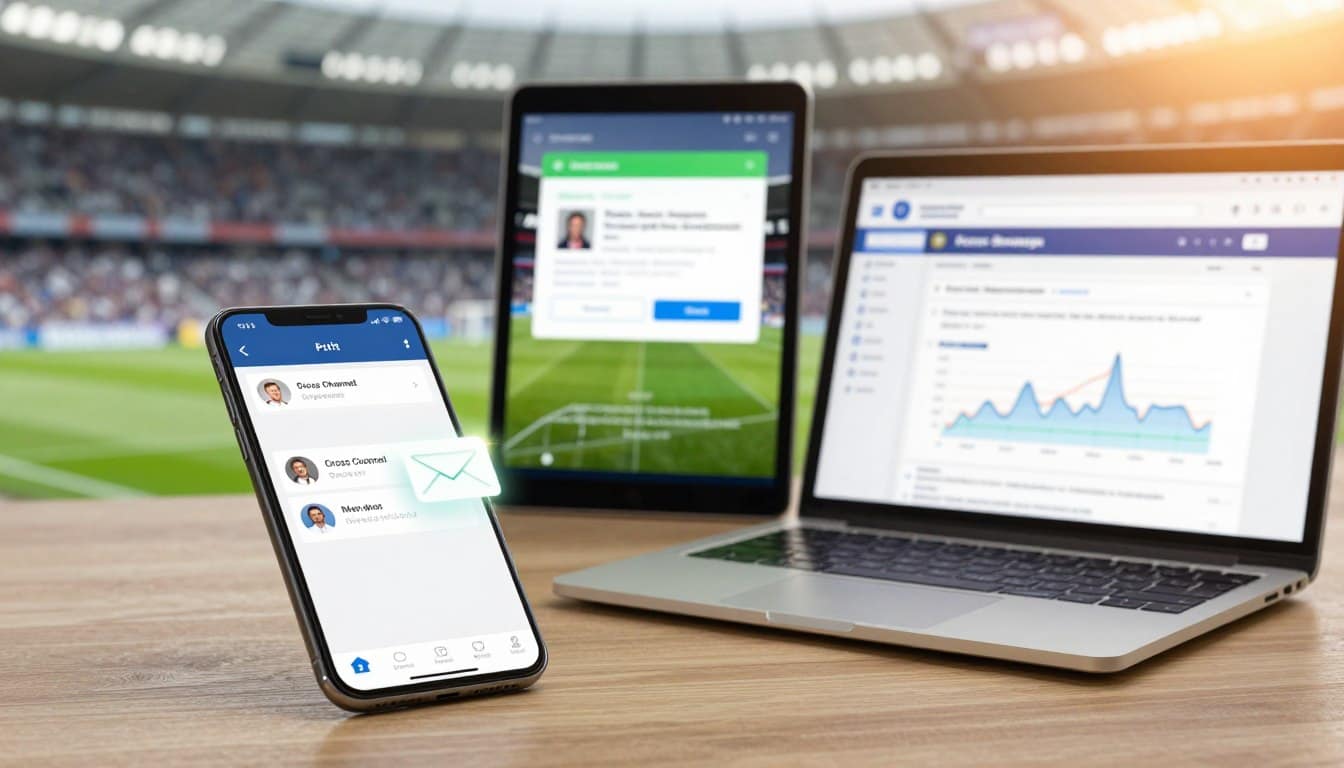
Promoting a game or match today is more than just announcing it. Fans are bombarded with info. Your message must be clear, timely, and wanted.
A single-channel approach won’t cut it. The best promotions use a coordinated, multi-channel strategy. This means combining different messaging platforms into one strong system.
This method, known as cross-channel messaging, matches how people get their news. Some check their email, others text alerts. It’s about meeting fans where they are.
By reaching fans on their preferred channels, you see better results. You get higher open rates, more engagement, and fuller seats. It turns promotion into a real conversation.
This guide will show you how to create this powerful toolstack. We’ll focus on real results like ticket sales and full houses.
Consent & compliance: CAN‑SPAM, TCPA/10DLC, GDPR—quick primer
Understanding consent rules is key to building trust with your fans. It ensures your messages are welcomed, not seen as spam. This trust boosts your open rates, click-throughs, and ticket sales.
Compliance is like a rulebook for your marketing. It keeps you safe from big fines and legal issues. It also shows your audience you value their privacy and inbox.
For sports promoters, three main rules are critical. You need to know CAN-SPAM for email, TCPA and 10DLC for SMS in the US, and GDPR for the European Union. We’ll make these rules simple and actionable.
Getting the right consent is your first step. The table below shows the key rules for each major regulation.
| Regulation | Applies To | Key Consent Rule | Key Disclosure Rule |
|---|---|---|---|
| CAN-SPAM Act | Commercial email in the U.S. | Implied consent is often accepted (e.g., business relationship). Explicit permission is best for marketing. | Must include a clear, working opt-out mechanism. Your physical postal address must be in the email. |
| TCPA & 10DLC | SMS/MMS messages in the U.S. | Requires prior express written consent. This means a clear “yes” from the recipient, often via a checkbox or text-to-join keyword. | Initial messages must identify your organization and state how to opt out. Messages must be sent during reasonable hours. |
| GDPR | Personal data of EU citizens, regardless of your location. | Consent must be freely given, specific, informed, and unambiguous. Pre-ticked boxes or assumed consent are invalid. | You must clearly state why you’re collecting data and how it will be used. Individuals have the “right to be forgotten.” |
Let’s see how this works in sports:
- Youth Sports Camps: When registering a minor, you must get parental consent before sending any promotional texts or emails. A clear opt-in checkbox on the registration form is essential.
- Season Ticket Holder Drive: Your opt-in language must be clear. Instead of “Sign up for updates,” use “Yes, I want to receive SMS alerts about game day changes, exclusive offers, and team news from [Team Name]. Msg & data rates may apply.” This meets the “informed” standard.
Managing opt-outs is critical. The process must be easy and immediate. For email, every message needs an unsubscribe link. For SMS, keywords like STOP must be honored automatically within seconds. Tools like EZ Texting for nonprofits can help manage these requirements.
Follow these best practices to stay compliant:
- Use clear consent language that specifies the channel (e.g., “text messages”) and the type of content (e.g., “promotional offers”).
- Keep detailed records of when and how you received permission. This is your audit trail.
- Respect “quiet hours” for SMS—typically between 9 PM and 8 AM in the recipient’s local time zone.
- Regularly scrub your lists against do-not-call registries (where applicable) and internal opt-out lists.
By mastering consent, you build a loyal fanbase that wants to hear from you. With the legal playbook understood, you’re ready to choose the right tools to execute your strategy.
Tool categories: email (Mailchimp/Klaviyo/HubSpot), SMS/MMS (Twilio/Attentive/EZ Texting), push (OneSignal/Airship/FCM)
Your toolkit needs three main channels: email, SMS, and push notifications. Each has its own role in connecting with fans. Choosing the right event marketing tools depends on the message’s urgency and purpose.

Let’s explore each category. We’ll look at their main uses and top platforms.
Email Marketing: The Campaign Workhorse
Email is great for detailed announcements and building loyalty. It supports rich designs and segmentation.
Mailchimp, Klaviyo, and HubSpot lead in this area. They help you create beautiful campaigns and manage complex lists.
Key strengths include advanced automation and deep analytics. Sports teams use email for season ticket drives and updates. Look for tools with strong deliverability and CRM connections.
SMS & MMS: The Instant Connection
SMS is perfect for urgent messages. It’s great for real-time alerts and two-way fan communication.
Twilio and Attentive offer robust APIs for custom integrations. EZ Texting has a user-friendly interface for quick messages. Infobip is key for global reach.
The real power for sports is two-way messaging. Fans can text for info or confirm attendance. This direct line boosts online engagement during major events. Prioritize providers with high deliverability and 10DLC compliance.
Push Notifications: The App-Based Nudge
Push notifications reach fans directly on their devices. They’re best for driving action within your app.
OneSignal, Airship, and Firebase Cloud Messaging (FCM) handle this channel. They send timely updates and deals to app users.
The main advantage is high visibility without needing an open inbox. For sports with a dedicated app, push is essential. Look for platforms with strong geo-targeting and quiet hour settings.
| Channel | Primary Use Case | Leading Platforms | Key Feature for Sports Events |
|---|---|---|---|
| Detailed campaigns, newsletters, and long-form content. | Mailchimp, Klaviyo, HubSpot | Advanced segmentation for ticket holders vs. general fans. | |
| SMS/MMS | Time-sensitive alerts, confirmations, and two-way chat. | Twilio, Attentive, EZ Texting | API triggers for real-time gate entry or weather updates. |
| Push Notifications | Instant, app-based alerts for driving in-the-moment action. | OneSignal, Airship, FCM | Geo-fencing to send offers to fans within the stadium. |
Building your stack means picking the best from each category. The right event marketing tools work together seamlessly. They ensure a smooth flow of information from your organization to fans.
Remember, the goal is a unified communication strategy. Your email, SMS, and push platforms should connect to your other data systems. This integration turns separate tools into a powerful engine for fan engagement.
Data and Integration: CRM/CDP, Ticketing, POS/Merch Connectors, UTMs
The real magic happens when tools work together. Alone, they miss the mark. But together, they create a personalized experience that boosts sales.
Your CRM or CDP is the heart of your system. It connects your email, SMS, and push tools. This is the first step to a connected toolstack.
This connection lets you segment your audience well. No more sending the same message to everyone. For example, season ticket holders get special deals, while others get parking reminders.
Here are key integrations for sports events:
- Ticketing Platforms (Eventbrite, Universe): Connect these to your messaging tools. Instant confirmations and upgrade offers are sent automatically.
- POS & Merchandise Systems: Link your store’s point-of-sale. Send messages about matching items or exclusive events to high-spending customers.
- Scheduling & Roster Tools: Sync team schedules and rosters to your CRM. Send messages about specific opponents or player milestones.
These integrations make segmentation dynamic and automatic. Your audience lists update in real-time, no manual spreadsheets needed.
But how do you know which message worked? UTM tracking is your answer. It adds tags to links in your messages.
UTM tracking tells Google Analytics where the click came from. For example, a link in an SMS about a halftime show is different from one in an email about playoff tickets.
Setting up UTM tracking is easy. Use free online builders. The main parameters are:
- utm_source: The channel (e.g., “sms”, “email”).
- utm_medium: The type (e.g., “promotional”, “transactional”).
- utm_campaign: The specific campaign name (e.g., “2024_opening_day”).
With this data, you can see which channel drove sales. This helps justify your marketing budget and improve future campaigns.
Integration turns data into action and action into insight. It’s the key to personalization and precision.
Message Architecture: The Four-Phase Campaign Blueprint
A successful promotion doesn’t rely on a single message. It needs a story that takes fans from curiosity to commitment. This structured approach is your message architecture. It turns sporadic notifications into a compelling story arc.
Think of it as a four-act play for your event. Each phase has a distinct goal and tone. When executed well, this framework significantly boosts open rates, click-throughs, and ticket sales.
Here is the proven four-phase architecture for any sports event promotion:
- Phase 1: Announce
This is your first official communication. The goal is to build clear awareness. Keep it factual and direct. Include all essential details: date, time, venue, and how to get tickets. Use this phase for critical updates, like a schedule change. Example template: “Heads up! The {team_name} game has been moved to 7:15 PM at North Arena. Update your calendar and secure your seats.” - Phase 2: Hype
Now, shift from informing to exciting. This phase generates anticipation. Share player spotlights, behind-the-scenes content, or rivalry history. Tease special halftime shows or guest appearances. The tone becomes energetic and emotive. Example template: “The rivalry reignites! See {team_name} star player #23 take on their historic foes. This matchup at {city} Stadium is one you won’t want to miss.” - Phase 3: Last-Chance
As the event date nears, leverage urgency. This is your final push to convert hesitant fans. Highlight limited ticket availability, rising prices, or exclusive last-minute offers. Use clear calls-to-action. Example template: “Final hours! Tickets for {team_name} vs. rivals are selling fast. Grab your spot in {seat_section} before they’re gone!” - Phase 4: Post-Game
The conversation shouldn’t end at the final whistle. This phase nurtures loyalty and sets up the next event. Send thank-you messages, share game highlights or a winning moment, and promote upcoming schedules. It’s key for retaining fans. Example template: “What a game! Thanks for being part of the electric crowd in {city}. Relive the top plays and mark your calendar for our next home game on [Date].”
This architectural flow ensures your audience receives the right message at the right time. It moves them logically through the customer journey.
Powering Your Messages with Personalization Tokens
While timing is critical, relevance is king. Personalization tokens are the secret weapon that makes each message feel individually crafted. They automatically insert fan-specific data into your templates.
Generic blasts get ignored. Personalized messages get opened. Using simple merge fields can dramatically increase engagement rates.
Here are the most effective tokens for sports marketing:
| Token | Description | Example Output |
|---|---|---|
| {team_name} | Inserts the fan’s favorite or local team. | “Your {team_name} are looking strong this season!” |
| {seat_section} | References the fan’s previous or purchased seat area. | “Your seats in {seat_section} are waiting for you.” |
| {city} | Uses the fan’s location or the event city. | “Don’t miss the biggest game in {city} this year!” |
| {first_name} | A basic but powerful token for direct address. | “{first_name}, you have a special offer inside.” |
Combine these tokens with your campaign phases for maximum impact. A last-chance message feels far more urgent when it mentions their team and their preferred seating section.
Implementing this two-part strategy—a timed architecture and smart personalization—creates a communication engine that builds genuine excitement and drives consistent results for every event on your calendar.
Deliverability: domain setup, warming, 10DLC registration, quiet hours
Without a solid deliverability strategy, your messages won’t get through. In sports marketing, deliverability means your emails or texts actually reach people. It’s the difference between a full stadium and empty seats.

For email, you need to prove you’re who you say you are. ISPs like Gmail and Outlook have strict filters. You must show you’re a real sender.
This means setting up three DNS records:
- SPF (Sender Policy Framework): Lists which mail servers are allowed to send email for your domain.
- DKIM (DomainKeys Identified Mail): Adds a digital signature to each email, verifying it wasn’t altered in transit.
- DMARC (Domain-based Message Authentication, Reporting & Conformance): Tells receiving servers what to do with emails that fail SPF or DKIM checks. It also provides reports.
Setting these up is essential. Next, you need to “warm” a new domain or IP address. Sending too much too soon looks like spam. You must slowly increase your sending volume over 4-8 weeks.
This builds a good reputation with ISPs.
SMS deliverability has its own key player: 10DLC (10-Digit Long Code). In the United States, all commercial SMS must now be registered through this system.
The 10DLC registration process involves:
- Registering your brand with The Campaign Registry.
- Providing detailed use cases for your messaging campaigns.
- Getting your long code numbers approved by mobile carriers.
This registration ensures your messages get through and reduces filtering. It’s like email authentication for text messages. Carriers use it to protect users from spam, so you must comply for reliable delivery.
Also, respect your audience’s time. “Quiet hours” are times when you shouldn’t send promotional messages. Sending a ticket reminder at 2 AM can lead to spam complaints and opt-outs.
Best practices for quiet hours include:
- Setting a default window (e.g., 9 PM to 9 AM local time).
- Using your CRM or messaging platform to automatically schedule sends for appropriate hours.
- Being extra mindful for national or early morning games.
Mastering these technical elements—domain setup, warming, 10DLC, and quiet hours—creates a reliable pipeline. Your creative messages will then reach fans, not get lost in the digital ether. Strong deliverability is the silent engine of your promotion toolstack.
Measurement: assisted conversions, attribution windows, holdout tests
The true strength of your promotional tools isn’t just in sending messages. It’s in measuring how much they boost your revenue. Going beyond simple metrics like open and click rates is key for sports marketers. Advanced methods show the real value of each channel.
This change turns basic campaign data into a detailed map of fan behavior. It shows you what drives ticket sales and merchandise purchases.
Assisted conversions uncover the hidden power of your channels. A fan might see an email, then click a last-chance SMS to buy. The email helped make that sale.
Your analytics platform can track this journey. Knowing the role of each channel helps you budget better. You stop underestimating channels that spark early interest.
Attribution windows set the time frame for giving credit. You must choose how long after an interaction a conversion counts. Common settings include:
- 7-day click: A conversion within 7 days of clicking a link.
- 1-day view: A conversion within 24 hours of viewing a message (without clicking).
- 30-day multi-channel: A longer window for complex, high-consideration purchases.
Set these windows in your Google Analytics, marketing platform, or CDP. Match them with your sales cycle. A single-game ticket might use a 3-day window, while a season package could need 30 days.
The ultimate test for proving value is the holdout test. This is a special A/B test where a control group gets no campaign message. You compare sales between the group that got your email or SMS and the group that did not.
The difference shows your campaign’s true incremental impact. Did you create new sales, or just sales that would have happened without your campaign? Holdout tests answer this key question.
Running these tests needs careful planning. You need a big enough audience to split statistically. Your marketing software should support this. The insights are priceless for getting more budget.
Mastering these three concepts—assisted conversions, attribution windows, and holdout tests—makes you a data-savvy marketer. You move from just reporting on activities to showing return on investment. This is how you prove your promotional strategy’s success.
Starter blueprint + budget calculator
Your measurement framework is ready. Now, create a launch plan for your sports event promotion. This starter blueprint provides actionable steps.
Start with compliance. Register your brand for 10DLC if you plan SMS campaigns. Also, authenticate your domain for email tools like Mailchimp or Klaviyo. Make sure you have consent for GDPR and TCPA regulations.
Choose one core tool per channel. For example, use HubSpot for email. Twilio or Attentive for SMS. OneSignal or Airship for push notifications.
Integrate your data. Connect these tools to a CRM or CDP. Also, sync with ticketing systems like Eventbrite or Universe. Use UTMs to track campaign performance.
Design your first campaign. Follow a message sequence: announce, hype, last-chance, and post-game. Personalize content with tokens for team, seat, and city.
Create a simple budget calculator. Estimate costs based on your list size and message volume. Remember to include platform fees from your tools. Also, account for setup costs for compliance and integration work.
This blueprint gives you a clear path forward. Launch your high-conversion toolstack, measure your results, and refine your approach for the next big game.


