
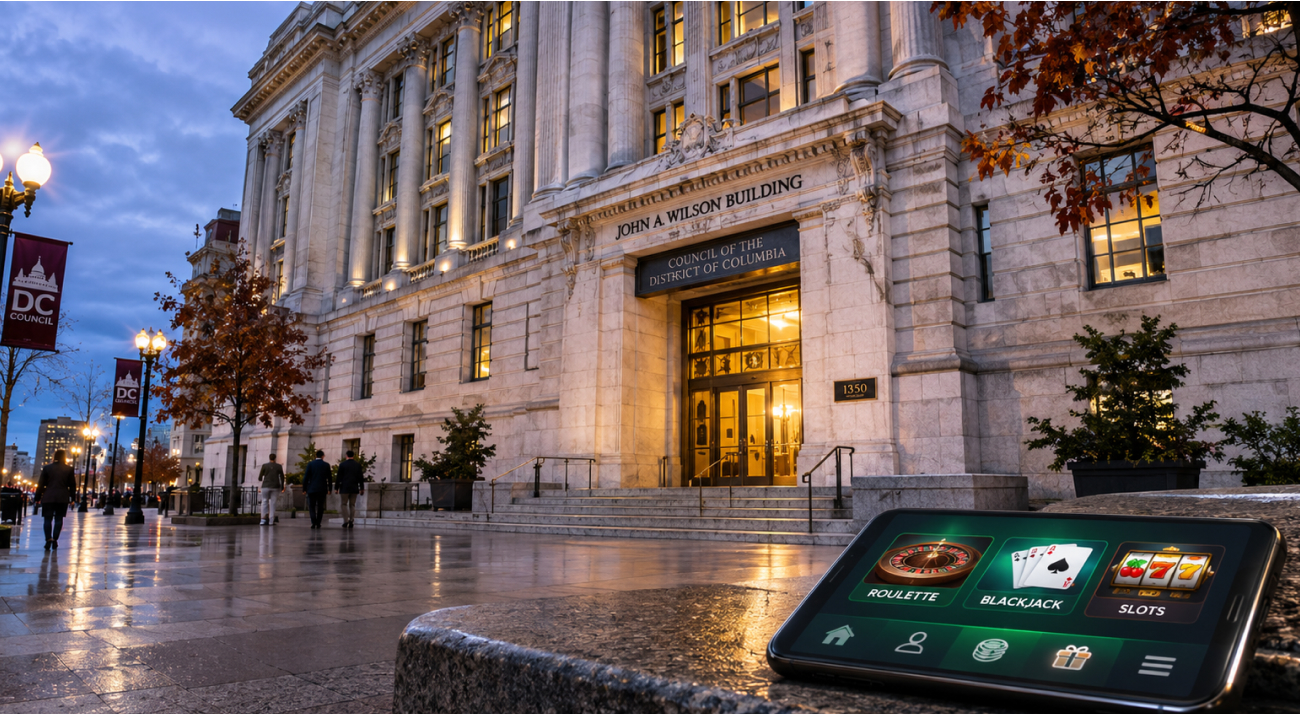
Washington, D.C., could become the next U.S. jurisdiction to authorize regulated real-money online casinos, with lawmakers facing a narrowing window to advance legislation before the end of 2026.
The proposal, known as the Internet Gaming and Consumer Protection Act of 2026, would establish a legal framework for online casino gaming in the nation’s capital, introduce a 25% tax on adjusted gross gaming revenue, and require operators to obtain licenses costing $2 million.
Introduced by D.C. Councilmember Wendell Felder, the legislation seeks to create a regulated market for internet casino games while establishing consumer protections and restricting certain sweepstakes-style gambling products.
The bill, designated B26-0656, remains under consideration by the Council of the District of Columbia. It has not been enacted, and real-money online casino gaming has not been authorized under the proposed framework.
According to reporting published by SBC Americas on November 2, the Council has only three remaining scheduled legislative meeting dates in 2026: November 10, December 1, and December 15.
That compressed schedule raises an important question for the U.S. gambling industry: Can Washington, D.C., approve online casino legalization before 2027, or will the proposal face further delays?
The outcome could affect major gambling operators, existing sports betting businesses, consumer protection policy, and the District’s future tax revenue.
Washington, D.C., Online Casino Legalization: Key Facts
Proposed iGaming tax
25%
Adjusted gaming revenue
License application fee
$2M
Proposed requirement
Remaining 2026 Council meetings
3
Nov. 10, Dec. 1 and Dec. 15
| Legislative detail | Current proposal |
|---|---|
| Bill | B26-0656 |
| Proposed law | Internet Gaming and Consumer Protection Act of 2026 |
| Introduced by | Councilmember Wendell Felder |
| Jurisdiction | Washington, D.C. |
| Proposed online casino tax | 25% of adjusted gross gaming revenue |
| Proposed application fee | $2 million |
| Additional focus | Consumer protection and sweepstakes casino restrictions |
| Legislative status | Pending; not enacted |
| Remaining scheduled 2026 Council meetings | November 10, December 1 and December 15 |
The proposal represents a potentially significant change in the District’s gambling policy.
Washington, D.C., already permits regulated sports betting, but that authorization does not automatically extend to online casino products such as digital slot machines, blackjack, roulette, and other casino-style games.
A separate legislative framework would be required to authorize and regulate those products.
The proposed legislation attempts to create that framework while establishing a new source of tax revenue for the District.
What Is the Internet Gaming and Consumer Protection Act of 2026?
The Internet Gaming and Consumer Protection Act of 2026 was introduced on April 9, 2026, by Ward 7 Councilmember Wendell Felder.
The bill was referred to the Council’s Committee on Human Services on April 21, and a public hearing took place on May 4.
As of November 3, the latest publicly reported status is that the proposal remains in committee, without a final Council vote.
The legislation would amend the District’s existing gambling laws to authorize online casino-style games played through mobile devices and computers.
Under the proposed system, the D.C. Office of Lottery and Gaming (OLG) would oversee licensing, regulatory compliance, consumer protection, and enforcement.
Which Online Casino Games Could Become Legal?
The legislation is intended to create a regulated environment for common real-money casino products, including online slots, blackjack, roulette, poker, and other authorized games.
Unlike online sports betting, where customers wager on the outcome of sporting events, online casino gaming generally involves digital versions of traditional casino games.
The distinction matters because existing sportsbook licenses would not, by themselves, authorize an operator to launch online casino products.
Companies would need to satisfy the new licensing and compliance requirements established by the legislation and any implementing regulations.
Why Councilmember Wendell Felder Supports the Proposal
Felder has argued that District residents already have access to offshore and unregulated online gambling websites, even though those platforms operate outside local regulatory oversight.
His proposal seeks to bring eligible activity into a licensed market, allowing the District to establish consumer safeguards and collect revenue.
In his official announcement, Felder said the legislation was designed to address existing gambling activity while generating funds that could be reinvested in local communities.
The proposal also includes measures intended to direct economic benefits toward District-based businesses. Council Member Wendell Felder
How Would Washington, D.C.’s Proposed 25% Online Casino Tax Work?
One of the legislation’s most important provisions is a proposed 25% tax on online casino gaming revenue.
The tax would apply to the relevant gaming revenue base defined by the legislation, rather than the total amount wagered by customers.
That distinction is essential when evaluating potential government revenue.
For example, if customers collectively wagered $100 million and received $92 million in winnings, the resulting gross gaming revenue would be $8 million before any additional permitted adjustments.
A 25% tax applied to an $8 million taxable revenue base would produce $2 million in tax revenue.
The actual amount would depend on the statutory definition of taxable revenue, allowable deductions, and operator activity.
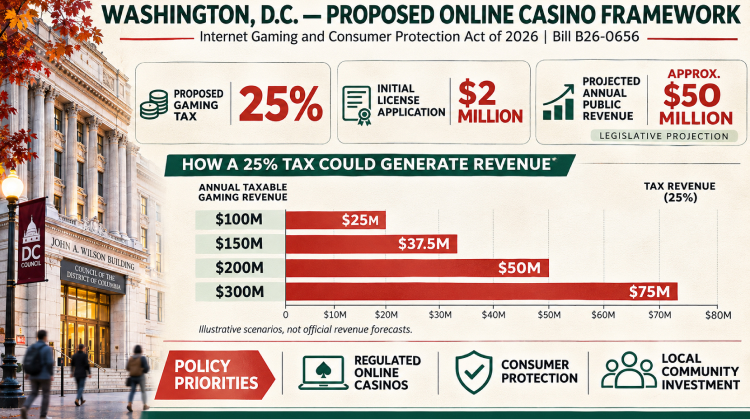
Illustrative Online Casino Tax Revenue Scenarios
The following examples demonstrate how a 25% tax could work under different annual taxable revenue assumptions. They are calculations, not official forecasts.
| Hypothetical annual taxable gaming revenue | Tax rate | Illustrative annual tax revenue |
|---|---|---|
| $100 million | 25% | $25 million |
| $150 million | 25% | $37.5 million |
| $200 million | 25% | $50 million |
| $300 million | 25% | $75 million |
Illustrative D.C. Online Casino Tax Scenarios
Hypothetical annual taxable gaming revenue and resulting tax receipts at a 25% rate; not official forecasts.
$0$20M$40M$60M$80M$100M revenue$150M revenue$200M revenue$300M revenue
How Much Revenue Could Legal Online Casinos Generate for D.C.?
In the bill sponsor’s announcement, the proposal was projected to generate more than $10 million in upfront licensing fees, approximately $50 million annually, and potentially more than $75 million annually within five years.
These are projections associated with the legislative proposal, not guaranteed receipts or revenue already collected.
They depend on factors including the number of licensed operators, the size of the legal market, customer participation, and the timing of implementation. Council Member Wendell Felder
Online Casino Licenses Could Cost Operators $2 Million
The proposed $2 million licensing application fee would represent a substantial initial expense for companies seeking authorization to offer online casino gaming in Washington, D.C.
A significant licensing fee can serve several purposes, including supporting regulatory administration and establishing financial requirements for market participants.
However, high entry costs may also affect competition.
Large operators with existing technology, compliance departments, and established gambling brands could be better positioned to absorb the initial expense than smaller companies.
The District would need to balance revenue generation and regulatory oversight against the benefits of a competitive market.
Which Online Casino Companies Could Be Interested?
If the legislation becomes law, operators with established U.S. online casino businesses could evaluate the District as a potential market.
Possible interested companies include:
- BetMGM, an established online casino and sports betting operator.
- DraftKings, which operates online casino products in authorized states.
- FanDuel, which combines online casino and sportsbook operations.
- Caesars Entertainment, which operates casino and sports wagering brands.
- Rush Street Interactive, the parent company of BetRivers.
These are examples of companies with relevant industry experience, not a confirmed list of D.C. license applicants.
Actual participation would depend on the final law, regulatory requirements, commercial considerations, and individual licensing decisions.
Washington, D.C., Could Ban Dual-Currency Sweepstakes Casinos
The legislation addresses more than conventional real-money online casinos.
It also proposes restrictions on certain dual-currency sweepstakes casino platforms.
These websites commonly offer virtual currencies used to play casino-style games. Some platforms provide a second promotional currency that may be redeemable for cash or prizes under specified conditions.
Supporters of tighter regulation argue that certain dual-currency arrangements can function similarly to real-money gambling without being subject to the same licensing, taxation, and consumer protection requirements.
The proposed D.C. legislation would prohibit qualifying unlicensed sweepstakes casino activity.
According to reporting on the bill, penalties could reach $100,000 per violation, increasing to $500,000 for repeat violations. CDC Gaming
Why Sweepstakes Casino Regulation Matters
The proposed restrictions reflect a broader debate about how U.S. jurisdictions should classify online gambling products.
Licensed online casinos must generally comply with requirements involving age verification, player identification, responsible gambling controls, game standards, and financial oversight.
Sweepstakes platforms have argued that their promotional models differ legally from conventional gambling.
Whether a particular product constitutes illegal gambling depends on its structure and the applicable law.
For Washington, D.C., combining online casino legalization with restrictions on unlicensed sweepstakes products could allow lawmakers to address both issues through one regulatory framework.
Consumer Protection Rules Would Be Central to D.C. Online Casinos
The bill includes a series of proposed consumer protection requirements intended to reduce risks associated with online gambling.
These provisions would apply to licensed operators if the legislation is enacted and implemented.
Minimum Gambling Age of 21
Customers would need to be at least 21 years old to participate in regulated online casino gaming.
Operators would be required to verify customer identities and implement safeguards against underage access and account misuse.
Deposit, Spending and Time Limits
The proposed framework includes responsible gaming tools such as deposit limits, spending limits, and time limits.
These features are intended to help customers monitor and control their gambling activity.
Self-Exclusion and Cooling-Off Periods
The legislation would also require mechanisms allowing customers to restrict their access to gambling platforms.
Self-exclusion can prevent participation for a defined period, while cooling-off tools may provide shorter breaks.
Protection of Customer Funds and Personal Information
Licensed operators would be expected to safeguard customer funds and personal data.
These requirements are particularly relevant for digital platforms that process payments, verify identities, and retain sensitive account information.
The proposed safeguards would not eliminate gambling-related harm, but they would establish enforceable requirements that do not necessarily exist on offshore or unlicensed websites. Council Member Wendell Felder
D.C. Proposes Community Reinvestment and Local Business Requirements
The Internet Gaming and Consumer Protection Act also contains provisions intended to distribute some economic benefits beyond gambling operators.
According to Felder’s office, the legislation would establish a 2% iGaming Community Reinvestment Fund to help address the social impacts of gambling.
Proposed funding priorities include financial literacy, debt management, gambling research, workforce development, and family support services.
The bill also includes a requirement directing operators to spend at least 35% of applicable operational expenditures with D.C.-based Certified Business Enterprises.
These measures could create opportunities for local businesses involved in technology, marketing, compliance, and professional services.
However, their effectiveness would depend on how the requirements are defined, enforced, and monitored.
Why Local Economic Benefits Are Part of the Debate
Online casino legalization is often discussed in terms of tax revenue, but its economic effects can extend into other sectors.
Licensed platforms require technology services, payment systems, cybersecurity, customer support, legal assistance, and regulatory compliance.
The District’s proposed local spending requirement is designed to direct a portion of that economic activity toward local companies.
At the same time, policymakers must consider the administrative costs of implementing the framework and the potential public health and financial consequences of expanded gambling availability. Council Member Wendell Felder
How D.C.’s Existing Sports Betting Market Could Influence Online Casino Legalization
Washington, D.C., already has experience regulating online gambling through its sports betting market.
The District legalized sports wagering in 2019 and initially relied on a lottery-centered mobile betting structure.
Its original citywide platform, GambetDC, launched in May 2020.
However, the system faced criticism over its performance, limited competition, and disappointing tax receipts.
According to SBC Americas, GambetDC generated approximately $4.3 million in tax revenue during its operation, compared with an earlier projection of $84 million.
In 2024, the District began moving toward a more competitive sportsbook market.
FanDuel replaced GambetDC as the primary citywide mobile provider in April, and regulatory changes effective July 15, 2024, expanded opportunities for other licensed sportsbooks.
BetMGM, Caesars, DraftKings, and Fanatics subsequently entered the broader mobile betting market. SBC Americas
Could Existing Sportsbooks Become Online Casino Operators?
Companies already operating sportsbooks in Washington, D.C., may have advantages if online casino legislation passes.
They may possess existing customer relationships, payment infrastructure, regulatory experience, and technology platforms.
The bill would also permit shared wallets between sportsbook and online casino accounts, subject to approval from the Office of Lottery and Gaming.
This could make it easier for eligible customers to access different authorized gambling products through a common account.
However, the District would still need to establish separate requirements for online casino licensing, game approval, and responsible gaming.
What Did Major Operators Say About the Proposal?
Several gambling companies participated in the May 4 legislative hearing.
DraftKings described online casino authorization as a logical extension of the District’s sports betting reforms.
BetMGM highlighted its existing investment in the D.C. market, while Caesars Entertainment also provided testimony supporting a regulated approach.
During the hearing, Ricardo Cornejo Rivas, Vice President of Online Gaming at Caesars Entertainment, discussed the potential benefits of licensing online casino products under District oversight.
The participation of established operators demonstrates commercial interest in the proposal, although testimony supporting legislation does not constitute a formal license application. dc.granicus.com+1
Why Some Groups Oppose Expanding Online Gambling in Washington, D.C.
Despite support from parts of the gambling industry, online casino legalization remains controversial.
Opponents argue that making casino games continuously accessible through smartphones could increase gambling-related harm.
Unlike traditional casino visits, mobile gambling platforms can be accessed at home and throughout the day, subject to legal and technical restrictions.
This raises concerns about excessive gambling, financial losses, and the effectiveness of responsible gaming safeguards.
At the May hearing, Stop Predatory Gambling opposed the legislation.
ARB Interactive, the company associated with Publishers Clearing House, also testified against the proposed sweepstakes restrictions. SBC Americas
The Central Policy Debate
Supporters argue that licensing existing gambling activity could improve oversight, reduce the role of unregulated operators, and create tax revenue.
Critics question whether additional tax receipts justify expanding access to high-frequency gambling products.
Both perspectives are relevant to evaluating the proposal.
The final policy decision will involve more than determining whether online casinos can generate revenue. Lawmakers must also assess consumer protections, enforcement costs, gambling-related harms, and the potential effects on existing businesses.
Can Washington, D.C., Pass Online Casino Legislation Before 2027?
The most immediate obstacle is the legislative calendar.
As of November 3, the proposal remains in the Committee on Human Services, chaired by Councilmember Matt Frumin.
The committee held a hearing on May 4 but has not advanced the bill to a final Council vote.
According to the Council calendar reported by SBC Americas, only three legislative meetings remain in 2026.
Remaining 2026 Legislative Timeline
- November 10, 2026First remaining scheduled legislative meeting. The proposal would need sufficient committee progress to move toward Council consideration.
- December 1, 2026Another potential opportunity for legislative action if the bill advances.
- December 15, 2026Final scheduled legislative meeting of the year, representing a critical deadline for the current proposal.
- January 2, 2027End of the current Council period. Unfinished legislation would need to be reintroduced in the next Council period.
The published calendar also includes Committee of the Whole meetings on November 24 and December 15.
A committee markup, committee approval, and additional legislative steps would still be necessary before the bill could become law.
Could the Bill Move Quickly?
Industry sources cited by SBC Americas on November 2 believe passage remains possible before the end of 2026.
However, that assessment does not mean Council approval is imminent.
The Committee on Human Services would need to act quickly, and the proposal would still require sufficient political support.
During the May hearing, at-large Councilmember Christina Henderson expressed uncertainty about the proposal’s merits.
The District is also undergoing a political transition following its November 3 elections, which could influence the legislative environment.
If the measure fails to advance before the current Council period ends, lawmakers would likely need to reintroduce it in 2027. SBC Americas
Would Online Casinos Actually Launch in Washington, D.C., in 2026?
Even if lawmakers approve the legislation before December 31, that would not necessarily mean online casinos could begin accepting real-money wagers in 2026.
Legal authorization and commercial launch are separate milestones.
Before licensed online casino platforms could operate, the District would need to complete regulatory and administrative work.
That could include finalizing regulations, reviewing applications, verifying technical systems, approving games, establishing compliance procedures, and confirming consumer protection controls.
Operators would also need to complete their own platform preparations.

Therefore, the most realistic distinction is between legalization before 2027 and operational online casino launches, which could occur later.
No official launch date has been established under the pending bill.
What Happens Next for Washington, D.C., Online Casinos?
The next major development to monitor is whether the Committee on Human Services schedules a markup or takes another formal step toward advancing B26-0656.
Several possible outcomes remain.
| Scenario | Potential consequence |
|---|---|
| Bill advances and passes in 2026 | D.C. begins the process of establishing regulated online casino gaming |
| Bill advances but is amended | Tax rates, fees, consumer protections, or other requirements could change |
| Bill remains in committee | No new online casino authorization under this proposal |
| Bill fails to pass before the Council period ends | A new proposal would likely be required in 2027 |
The current 25% tax rate, $2 million license fee, and other provisions should be treated as proposed terms until the legislation is finalized.
For gambling operators, the District represents a potential new market.
For policymakers, the decision involves balancing new public revenue against regulatory costs and the risks associated with expanded gambling access.
For residents, the outcome could determine whether they eventually gain access to locally licensed online casino products with formal consumer protections.
Frequently Asked Questions
Is online casino gambling legal in Washington, D.C., in 2026?
Washington, D.C., permits regulated sports betting, but the pending Internet Gaming and Consumer Protection Act has not yet authorized the proposed real-money online casino market.
What is B26-0656?
B26-0656 is the Internet Gaming and Consumer Protection Act of 2026, introduced by Councilmember Wendell Felder on April 9. It proposes legal online casino gaming, licensing requirements, taxation, and consumer protections.
What tax rate would Washington, D.C., charge online casinos?
The bill proposes a 25% tax on adjusted gross gaming revenue.
How much would a D.C. online casino license cost?
The legislation proposes a $2 million application fee for a five-year operator license, with a $500,000 fee for each five-year renewal.
Would DraftKings, FanDuel, BetMGM, and Caesars offer online casinos in D.C.?
These companies have relevant gambling operations and could consider the market if legalization occurs. However, no online casino licenses have been awarded under the proposed legislation.
Would the bill ban sweepstakes casinos?
It would prohibit qualifying dual-currency sweepstakes gambling products, with enforcement mechanisms and financial penalties for violations.
How much tax revenue could online casinos generate for Washington, D.C.?
The bill sponsor has projected approximately $50 million annually, potentially increasing beyond $75 million within five years. These estimates are projections, not guaranteed results.
When could Washington, D.C., legalize online casinos?
Passage remains possible before the end of 2026, according to recent industry reporting, but the bill is still in committee. The remaining scheduled legislative meetings are November 10, December 1, and December 15.
Could online casinos launch immediately after the bill passes?
Not necessarily. Regulatory implementation, operator licensing, technical approvals, and compliance preparations would likely be required before commercial operations could begin.
Conclusion: Washington, D.C., Faces a Critical Decision on Online Casino Legalization
Washington, D.C., is approaching an important moment in its gambling policy.
The Internet Gaming and Consumer Protection Act of 2026 would establish a regulated online casino market, impose a 25% tax on adjusted gaming revenue, introduce $2 million operator licensing fees, and implement consumer protection and enforcement requirements.
Supporters believe the proposal could generate approximately $50 million in annual public revenue while bringing existing online gambling activity under local oversight.
However, concerns about gambling-related harm, competition, and implementation remain central to the debate.
The legislative timetable is also increasingly challenging.
With only three scheduled legislative meetings remaining in 2026 and the proposal still in committee, lawmakers have limited time to act.
Washington, D.C., could approve online casino legalization before 2027, but passage is far from certain.
Whether the bill advances this year or returns in a future legislative session, the debate demonstrates how online casino regulation is becoming an increasingly important issue for U.S. policymakers.
For the gambling industry, the District’s decision could provide another indication of how jurisdictions balance commercial opportunities, tax revenue, consumer protection, and the risks associated with expanded digital gambling.