
Welcome! The big game isn’t just played on the field anymore. It unfolds live across Twitter, Instagram, and every other platform where fans gather. Every comment, hashtag, and shared meme is a vital piece of the modern fan experience.
But here’s the real question: are you just watching the chatter, or are you equipped to understand and act on it? For over half of customer experience leaders (56%, to be exact), the answer is a resounding yes—they’re increasing their investment in these channels as a primary way to connect.
This is where powerful tools come in. Think of them as your command center. They monitor conversations, perform sentiment tracking to gauge fan emotion, identify rising trends, and package it all into clear reports. Brands like Ben & Jerry’s have famously used this approach to inform everything from new flavors to marketing campaigns.
We’re moving beyond simply replying to mentions. The true goal is to find that “content gold”: the perfect, authentic fan moments that make your posts unbeatable. With the right dashboards, you get an all-access pass to the world’s largest, most passionate focus group—your audience. Let’s transform how you connect when it matters most.
Define Listening Objectives: community care vs content gold
More than half of brands use social listening to understand customer attitudes. Your goals will guide everything. Are you protecting your team’s reputation or finding great content? Let’s explore what this means for you.
Before setting up tools, we must clearly define our listening objectives. It’s like having a game plan. You wouldn’t start a game without one, right? Your social media strategy needs focus too.
Research shows 57% of professionals use social listening to grasp customer attitudes. Also, 55% monitor brand health. These stats highlight our two main goals: Community Care and Content Gold.
Community Care is your defensive playbook. It involves social monitoring. It’s reactive and essential. Your aim is to safeguard your brand’s image by addressing complaints and answering fan questions.
You might handle a negative comment about stadium food or a fan’s confusion about ticket policies. This mindset is about protection and support. You’re defending your brand.
Content Gold, on the other hand, is your offensive strategy. It’s proactive social listening. You’re not just waiting for mentions; you’re actively searching for valuable content. This includes funny memes, touching fan stories, and lively debates.
This goal is about understanding why fans are talking, not just that they are. It’s the difference between seeing a hashtag and knowing the emotional story behind it. This gold enriches your content calendar and celebrates with your community.
| Aspect | Community Care | Content Gold |
|---|---|---|
| Primary Goal | Protect brand reputation & support fans | Discover engaging stories & creative content |
| Mindset | Defensive, reactive | Offensive, proactive |
| Key Actions | Answer questions, resolve complaints, provide info | Identify trends, spot creators, join positive conversations |
| Outcome | Trust and loyalty | Engagement and virality |
In reality, you’ll want a mix of both! A great game day strategy has a solid defense and a creative offense. By defining these listening objectives upfront, you create a setup that serves both purposes.
You ensure you never miss a chance to defend your team’s honor or to share in a fan’s joyful moment. Now, with your goals set, you’re ready to build the specific queries that will bring these conversations to your dashboard.
Build Queries: team names, nicknames, rivals, player handles, misspellings
Creating keyword clusters broadens your social listening. It turns a narrow spotlight into a wide floodlight. Your queries act like a net to catch all fan conversations.
Using only your official team name misses the real, messy fan chatter. Modern tools can track your brand and products, even without official tags. They also watch your competitors, giving you a strategic edge.
Your goal is to capture all discussion—keywords, topics, and public sentiment. So, how do you build this net? Think like a fan!
- Official Names & Nicknames: Include “[Team Name]”, the team mascot, and local monikers like “[City] Squad.” Don’t forget abbreviated versions fans use in quick tweets.
- Player-Specific Terms: This goes beyond star player handles (@StarPlayer). Add jersey numbers (#23), common nicknames, and even their hometown references.
- Rivals & Opponents: When fans talk about your biggest rival, it often signals hype for an upcoming matchup. Tracking these names provides key context.
- Hashtags: Integrate official game-day hashtags, player-specific tags, and fan-created movements. For a deep dive on this tactic, check out our guide on maximizing event hashtags.
- Common Misspellings & Slang: You’d be shocked how much volume exists for “Go [Mispelled Team]!” or local slang for your team’s name.
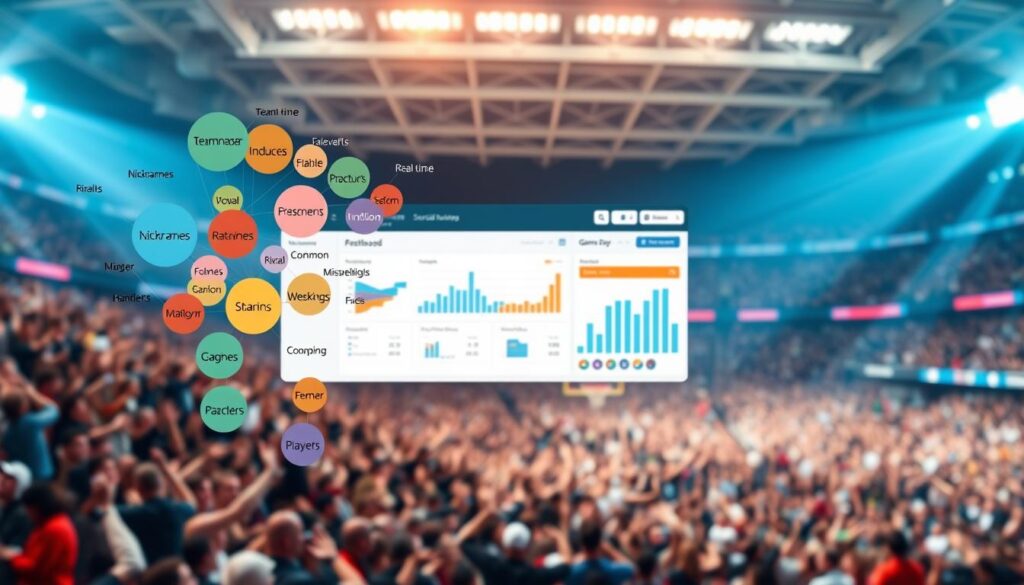
Organizing terms into keyword clusters makes your dashboard a powerful magnet. It pulls in every conversation aspect, from joy to frustration. This way, you see the whole story, not just highlights.
This method catches content gold and community care chances. You’ll find fans creating amazing videos, newcomers asking questions, and frustrated fans needing help. It’s all in the data, waiting for your well-built query.
A single keyword is a guess. A keyword cluster is a strategy. It’s the difference between hearing a few voices and understanding the whole stadium.
Dashboards: volume, sentiment, topics, creators, geo heatmaps
Your dashboard is like the control room for game day. It turns millions of tweets and posts into a clear picture. This is where your queries come to life as visual intelligence.
Instead of getting lost in text, you get a clear view. Tools like Sprout Social and Brandwatch offer these advanced dashboards. They make noise into signals you can act on.
Here are the five key widgets you’ll rely on:
- Volume Graph: Watch the conversation spike at key moments like kickoff or a game-winning touchdown!
- Sentiment Tracking: Is the fan mood celebratory or frustrated? This is your real-time emotional pulse check.
- Trending Topics: See which players, plays, or controversies are dominating talk right now.
- Top Creators & Influencer Detection: Automatically spot the most influential fans and journalists driving the conversation.
- Geo Heatmaps: Discover where in the country or world the chatter is hottest. Perfect for regional marketing!
To understand how each piece helps you, let’s break them down side-by-side.
| Dashboard Widget | What It Shows You | Why It Matters | Example Game Day Insight |
|---|---|---|---|
| Volume Graph | The raw number of mentions over time. | Identifies peak engagement moments for timely posting. | A huge spike occurs immediately after a controversial referee call. |
| Sentiment Tracking | The ratio of positive, negative, and neutral mentions. | Gauges overall fan mood and spots possible PR issues early. | Sentiment turns sharply negative after a key player is injured. |
| Trending Topics | The most frequently used words and hashtags. | Reveals what the conversation is *actually* about. | #WorstCallEver is trending, indicating fan anger over a specific play. |
| Top Creators/Influencers | Accounts generating the most reach or engagement. | Enables influencer detection for possible partnerships or shout-outs. | A local sports blogger’s thread is being shared thousands of times. |
| Geo Heatmap | A visual map showing mention density by location. | Unlocks geographic targeting opportunities. | Unexpected high volume in a new market signals growing fan base there. |
The influencer detection capability is very powerful. It helps you move from just watching the crowd to finding leaders. These are your possible brand ambassadors or community voices.
Mastering these data analytics dashboards gives you a huge strategic advantage. You’re not just reacting. You’re anticipating and engaging with precision. It’s your cockpit view for navigating the entire social game.
Real‑Time Alerts: thresholding and routing to the right owner
Imagine having a digital assistant that alerts you to important online moments during the game. That’s what real-time alerts offer. You don’t need to watch a dashboard for hours. These alerts act as your early warning system, making sure you catch every key moment.
Thresholding is the key. It lets you set rules for when to alert you. It’s like setting a custom alarm for your brand.
For instance, you might alert yourself when your star rookie gets more than 500 mentions in a minute. This is a spike alert for catching viral moments. Or, you could alert the PR team if negative talk about the coach’s decision increases by 30% in 10 minutes.
When a threshold is hit, intelligent routing kicks in. This makes sure alerts go to the right person quickly. They don’t get lost in a general inbox.
Here’s who usually gets what:
| Alert Trigger | Threshold Example | Routed To | Potential Action |
|---|---|---|---|
| Mention Volume Spike | 500+ mentions/min for a player | Social Media Manager | Create celebratory post, share fan content |
| Negative Sentiment Shift | 30% increase in negative brand talk | PR / Communications Team | Draft a clarification, prepare a statement |
| Specific Keyword Mention | Posts containing “referee call” + “bad” | Community Manager | Engage with factual info, provide context |
This method helps your social manager get the fun moments. Your customer care team knows about complaints quickly. Your PR team is ready for crises. It turns data into actionable intelligence.
With smart thresholding and routing, you create a system that works on its own during the game. The right person gets the right info at the exact right time. You move from just watching to actively engaging, grabbing every chance and avoiding risks as they happen.
Turn Signals into Posts: Q&A, myth‑busts, clarifications, shout‑outs
Finding the signal is step one. The real magic happens when you turn that insight into content that connects. Your dashboard is full of these opportunities. Let’s turn them into your next great post.

A SaaS company might use customer questions to rebuild its onboarding tutorial. For your team, every fan comment is a clue. It shows what they care about right now. Your response turns that casual conversation into community loyalty.
Here are four powerful ways to act on what you hear:
- Fan Q&A Mining: See the same question popping up across platforms? (“Is Player X starting?” “Where’s the merch truck?”) That’s pure gold. Create a quick, clear FAQ graphic or a 15-second video answer. This proactive fan Q&A mining stops repetitive questions and makes everyone feel heard.
- Myth-Busts: Misinformation can spread faster than a highlight reel. If you spot a false rumor gaining traction, don’t ignore it. A calm, factual correction post from your official channel can stop it in its tracks and position you as the trusted source.
- Clarifications: Confusion about a controversial call or a complex rule? A simple explainer video or infographic can work wonders. It shows you’re listening to the confusion and care enough to provide clarity, which hugely builds trust.
- Shout-Outs: This is where you can really spread the love. See an amazing fan-made video, a touching story, or incredible game-day attire? Share it! Amplifying your community’s voice is the ultimate way to say, “We see you, and we think you’re awesome.”
This approach does more than fill your content calendar. It changes your channel’s entire feel. You move from a one-way broadcast to a dynamic, two-way conversation. Fans start to love checking your feed because they know it might feature them or answer their burning question.
By responding directly to the intent behind comments, you’re not just posting—you’re building a stronger, more engaged community every single game day.
Customer Care Playbook: response SLAs, macros, escalation
Imagine cutting your support tickets by 20% with a ready-made guide for your customer care team. Game day moves fast. Fans are excited, emotions run high, and questions flood in. Without a plan, your team is left reacting—and potentially missing critical issues. A customer care playbook changes that. It’s your pre-game strategy for turning fan inquiries into positive interactions, every single time.
Think of this playbook as your team’s rulebook. It tells everyone exactly what to do, when to do it, and how. This isn’t about making responses robotic. It’s about freeing up your staff’s mental energy so they can provide genuine, helpful support. Let’s break down the three core plays you need to script.
1. Set Clear Response SLAs (Service Level Agreements)
An SLA is a promise. It tells your fans how quickly they can expect a reply. During a live game, speed builds trust. A fan with a broken streaming link needs help now, not tomorrow.
Your playbook should define different SLAs for different channels and issue types. For example:
- Twitter/X Customer Questions: Respond within 30 minutes.
- Facebook Comments on Official Posts: Acknowledge within 1 hour.
- Urgent Issues (e.g., fraudulent ticket sales): Escalate immediately for a 15-minute response.
Post these goals internally so your team knows the target. This clarity is what lets you measure success and show fans you’re reliable.
2. Create Pre-Approved Macros for Common Issues
Why type the same answer fifty times? Macros are pre-written, on-brand response templates for frequent questions. They are huge time-savers.
Common game-day macros might address:
- Merchandise store shipping delays
- Official app login problems
- TV broadcast channel information
- Stadium gate policies
The key is that staff personalize them. They should add the fan’s name, reference a specific player if relevant, and adjust the tone. A good macro provides 80% of the answer, letting your agent fill in the last 20% with a human touch. This is how you address widespread confusion efficiently, directly cutting down the volume of repetitive support tickets.
3. Define Crystal-Clear Escalation Paths
Not every question has a simple answer. Some issues are too complex, sensitive, or urgent for a front-line responder. Your playbook must map out the escalation process.
This is where intelligent routing comes into play. Define rules like: “Any post mentioning legal action gets flagged and routed directly to the community manager.” Or, “Complaints about offensive content in the stands are escalated to the PR team within 5 minutes.”
A clear path prevents small problems from blowing up. It ensures the right expert handles the right issue at the right time.
To tie it all together, here’s a quick-reference table that shows how these elements work in harmony for different fan scenarios.
| Fan Inquiry Type | Recommended SLA | Macro to Use | Escalation Trigger |
|---|---|---|---|
| “Where can I watch the game? My cable is out!” | 15 minutes | Broadcast & Streaming Options | None – resolve with macro. |
| “My tickets in section 101 aren’t scanning at the gate.” | 30 minutes | Stadium Entry Troubleshooting | If not resolved in 10 mins, escalate to on-site stadium staff. |
| “Someone is selling fake jerseys using the team’s logo.” | Immediate (5 mins) | Brand Protection Alert | Auto-escalate to legal/brand protection team. |
| “The audio on the official stream is 10 seconds behind.” | 1 hour | Technical Streaming Issues | If multiple reports, escalate to broadcast partner. |
With a solid customer care playbook in place, your team shifts from being overwhelmed responders to confident problem-solvers. You build fan loyalty by showing you’re prepared and you care. So, before the next kickoff, huddle up and write your plays. Your fans—and your stress levels—will thank you.
Crisis Triage: false info, harassment, sensitive footage
Your social listening dashboard is not just for finding good content. It’s also your early warning system for brand crises. Being ready for tough times is key to being proactive, not just reactive. This is where your crisis triage plan comes in—a clear set of steps to handle harmful content before it hurts your community or reputation.
Think of it like a digital first aid kit. The goal is to identify issues quickly and apply the right response to minimize impact. Good reputation management starts by spotting PR crises early, before they become big problems.
Let’s break down the three most common game-day emergencies and how to handle them:
- False Information & Rumors: From fake player trades to incorrect score updates, misinformation spreads fast.
- Harassment & Hateful Speech: Targeted abuse against players, staff, or other fans has no place in your community.
- Sensitive or Distressing Footage: If serious content, like a player injury, circulates, your response must be compassionate and official.
For false information, speed and clarity are your best tools. Your team should have a pre-approved process for issuing swift, factual corrections from verified accounts. Don’t just delete the rumor—address it head-on with a calm, authoritative post that provides the truth. This stops the chain of speculation and establishes your brand as a trusted source.
Combating harassment requires a two-part strategy: monitoring and action. Use sentiment and keyword alerts to flag hateful speech. Know your platform’s reporting tools inside and out. More importantly, have a public policy. Decide when to directly engage (often, a simple “This is not acceptable here” comment from the official account), when to report to the platform, and when to make a broader statement condemning the behavior. Protecting your community is non-negotiable.
The spread of sensitive footage is a delicate situation. If a distressing event occurs, your first priority is compassion, not content. Pause scheduled promotional posts. Quickly convene with leadership to decide on an official, empathetic response. This might be a brief statement wishing a player a speedy recovery or acknowledging a serious situation. The key is to show humanity and control the narrative with care.
By planning for these scenarios, you do more than just protect your brand’s integrity—you safeguard the fans who support you. A robust crisis triage protocol ensures that even on the most chaotic game days, your team can respond with confidence and care. This level of preparedness is a cornerstone of a truly holistic sports content marketing strategy, where protecting your community is as important as engaging them.
Post‑Mortem: tag what worked; refine queries for next match
The final whistle blows, but your social listening work is just entering its most valuable phase. A thorough post-mortem turns one game’s data into your playbook for the entire season.
Start by tagging what worked. Go back to your dashboards and find out which fan signal got the most engagement. Was it a player shout-out on Instagram or a myth-busting reply on Twitter? Tag these wins. This helps you track your performance and see what fans love.
Next, refine your queries. Did fans use a nickname you missed? Was there too much irrelevant noise in your results? Tools like those from Brandwatch or Sprout Social can help. Use these insights to make your keyword clusters sharper for next time.
Analyze the sentiment shifts you observed. Note how fan mood changed after a big play or a controversial call. Understanding these swings prepares you for future emotional peaks and valleys in the conversation.
This cycle of listen, engage, and learn is the core of a winning strategy. Your post-mortem closes one game but opens a smarter, more connected content and community strategy for the matches ahead.