
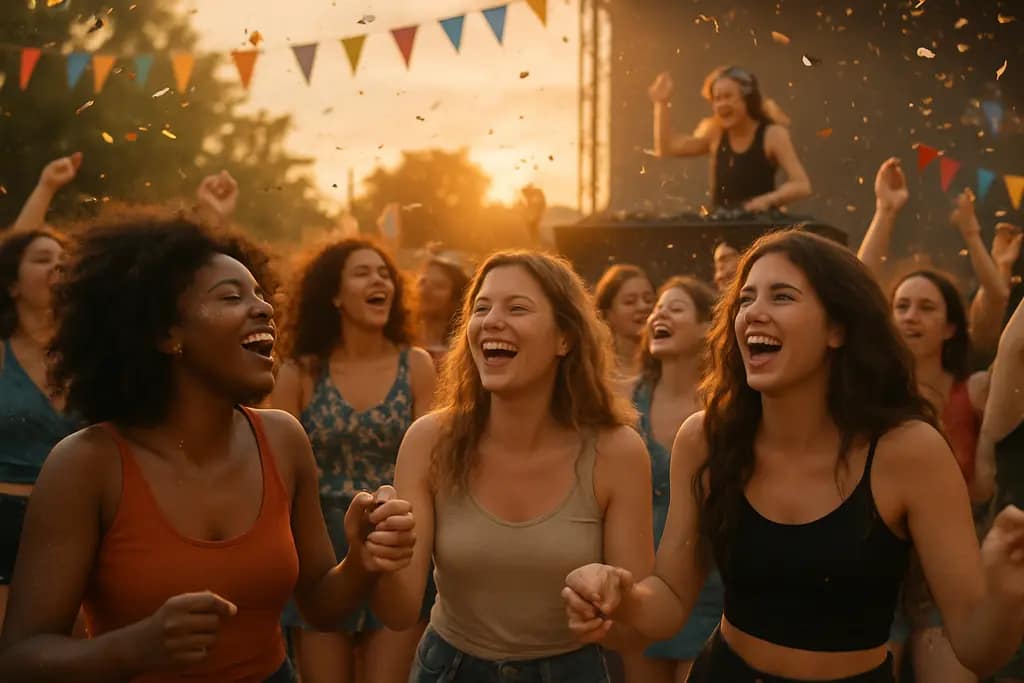
female-led music festivals have become more than programming statements. They are now audience-engagement tests: who feels invited, who sees themselves reflected onstage, and whether cultural goodwill can be converted into attendance, donations, social sharing, and repeat loyalty. The clearest recent case came from Daisy Chain Fields Festival in 2026, which was reported as an all-female lineup that raised US$20 million, with half donated to women’s rights organizations, according to The Atlantic review. That result is confirmed as reported by the publication, but its wider meaning needs caution: one successful event does not prove that gender-focused billing alone produces durable cultural change.
Market-analysis: the value of these festivals sits at the intersection of representation, live-event economics, fan identity, and cause-linked participation. Audiences are not only responding to sound or celebrity scale. They are responding to the sense that a festival can act as a public argument about who gets premium stage time. For cultural media, that changes how a lineup is read. A poster is no longer just a schedule; it is a visible measure of institutional priorities.
Why female-led music festivals Have Become A Cultural Signal
What The Data Says About female-led music festivals
Confirmed: representation gaps remain significant in major U.S. festival booking. Book More Women reported that across nine major U.S. multi-genre music festivals in 2025, only 22% of musicians booked were women, based on its published lineup tracking at Book More Women data. That figure matters because it gives the cultural debate a measurable baseline. Without a number, conversations about parity can drift into impressions. With a number, festivals, sponsors, media partners, and fans can compare rhetoric with actual billing.
Audience-analysis: the contrast between that 22% figure and the reported Daisy Chain Fields model helps explain why female-led programming can carry symbolic weight. When a festival offers an all-female lineup in a sector where women remain underrepresented across major bookings, the event reads as a corrective as much as an entertainment product. That does not mean every fan interprets it the same way. Some attend for artists, some for the social atmosphere, some for politics, and some for the scarcity of seeing many women centered at once. The cultural effect comes from the overlap of those motives.
Why A Lineup Poster Now Functions Like Media
Reviewed opinion: festival lineups circulate as cultural texts before a single set begins. They are shared, criticized, praised, screenshotted, and compared across fan communities. For a female-centered event, that circulation can become part of the engagement engine. Fans often build meaning before arrival: planning outfits, comparing set conflicts, debating omissions, and treating attendance as a public identity signal.
This behavior resembles the fan participation seen across other entertainment formats, from morning concert broadcasts to reality television ecosystems. Platforms like TrueRealTV illustrate how audience attention often moves across music, personality-driven media, and fan conversation. The responsibility of cultural media is to differentiate confirmed event outcomes from broader cultural assumptions.
The Booking Gap Behind The Celebration
Parity Claims Need Specific Measures
Confirmed: the available cited data shows that women were still a minority of booked musicians across the nine U.S. multi-genre festivals tracked in 2025. Market-analysis: that means high-profile female-led festivals should be read in two ways at once. They are signs of demand and cultural momentum, but they also expose how uneven the broader booking system remains. Celebration and critique are not opposites here; they depend on each other.
One risk is that a small number of visible events allows the wider sector to claim progress before the pattern changes at scale. A festival with an all-female lineup can generate headlines, brand warmth, and fan enthusiasm. Yet if most large festivals continue to book women at much lower rates, the effect may remain concentrated rather than systemic. The data does not support a claim that parity has been reached across the U.S. festival market. It supports a narrower claim: some events are using female-centered programming to challenge a documented imbalance.
Headliners Carry Extra Cultural Weight
Market-analysis: not every booking slot has the same audience meaning. A woman added to a midday undercard does not carry the same visibility as a woman closing a main stage. Headline placement shapes press coverage, social video circulation, sponsor creative, and post-event memory. That is why fan debate often focuses less on whether women appear somewhere on a bill and more on whether women are trusted with the most visible moments.
This distinction is especially important for female-led music festivals because the format changes the default story. Instead of asking whether women can be included, the audience sees women as the organizing center. That shift can affect how fans talk about belonging, safety, taste formation, and community. Still, the evidence should be framed carefully: the available public data supports a representation gap and a successful female-centered case, not a universal formula for every market or genre.
How Fans Turn Lineups Into Participation
Attendance Is Only One Engagement Signal
Audience-analysis: the cultural impact of a festival cannot be measured only by gate count. Attendance matters, but fan engagement also shows up through donation behavior, user-generated content, artist discovery, newsletter signups, merch demand, local travel, and post-event discourse. Daisy Chain Fields’ reported fundraising total is especially relevant because it tied festival participation to a civic cause. That type of result suggests that fans may respond when the event gives them a way to connect entertainment spending with values-based action.
Confirmed with caution: the reported US$20 million raised by Daisy Chain Fields, with half donated to women’s rights organizations, is evidence of financial activation around one event. It does not prove that every similar festival will raise comparable sums. Artist draw, ticket pricing, sponsor support, venue scale, local demographics, and media attention all affect outcomes. The better reading is that cause-linked programming can deepen participation when the audience already trusts the premise.
- Market-analysis: representation can make a festival feel culturally distinct before the first performance.
- Audience-analysis: fans may treat attendance as both entertainment and public affiliation.
- Confirmed: 2025 U.S. lineup data still showed women far below parity across the sampled major festivals.
- Reviewed opinion: cause-linked giving can extend a festival’s story beyond the venue.
Fandom Becomes A Distribution Channel
Female-led music festivals also benefit from fan-to-fan circulation. Clips, set reviews, outfit posts, group-chat recommendations, and creator commentary can carry the event into spaces that paid advertising may not reach. This is not unique to women-led events, but the identity dimension can sharpen the sharing motive. Fans are not only saying that a performance was good. They may also be saying that the booking choice itself mattered.
That type of peer distribution has limits. Online enthusiasm can overstate broad demand, especially when the loudest fan communities are not representative of the ticket-buying public. Still, it gives organizers a feedback loop. If fans are sharing lineup analysis, donation totals, stage moments, and artist discovery stories, the festival has generated more than passive attendance. It has produced material for social identity and cultural argument.
Distribution, Sponsors, And Media Value
Why Sponsors Read Representation As Risk And Opportunity
Market-analysis: sponsors often view festivals through reach, brand safety, audience demographics, and earned media. A female-centered festival can offer a clear identity, but it also requires alignment. A brand that treats representation as a slogan without supporting the event’s stated values may face skepticism. A brand that helps fund access, artist development, community programming, or cause-linked giving can become part of the audience’s positive memory.
For entertainment publishers and partner sites, the same caution applies. Coverage should avoid flattening the event into celebrity spectacle. Related entertainment outlets such as TrueRealTV show how audience attention often moves across music, personality-driven media, and fan conversation. The responsible editorial task is to separate confirmed event outcomes from assumptions about culture-wide change.
Media Rights And Afterlife Matter
Female-led music festivals also raise questions about distribution after the gates close. Short-form clips, documentary packages, streaming rights, artist interviews, and sponsor recaps can extend the life of a festival. Market-analysis: the event’s value may depend less on one weekend and more on whether its cultural story remains visible after the live audience leaves.
That afterlife should be handled with care. If the programming is framed only as novelty, the message fades quickly. If it is tied to measurable representation gaps, artist development, and fan participation, it can become part of a longer conversation about how live music allocates prestige. The audience does not need inflated claims. It needs evidence, context, and visible follow-through.
What female-led music festivals Mean For Audience Engagement
The most defensible reading is that female-led music festivals are not a cure-all for gender imbalance in live music, but they are a visible pressure point. They show what happens when organizers place women at the center rather than treating them as quota-sensitive additions to a conventional bill. They also give fans a clearer story to organize around: attendance as support, sharing as advocacy, and spending as cultural participation.
The 2025 booking figure from Book More Women keeps the analysis grounded. If only 22% of musicians booked across the tracked major U.S. multi-genre festivals were women, then the cultural importance of female-centered events is partly that they make the gap harder to ignore. Daisy Chain Fields, as reported in 2026, added another layer by connecting an all-female lineup with major fundraising and donations. Those facts support a cautious conclusion: representation can become an engagement strategy when it is visible, measurable, and linked to audience values.
For organizers, the lesson is not simply to copy one model. It is to treat lineup design as audience communication. For sponsors, it is to support the values the event claims. For media, it is to report the numbers without overstating what one festival can prove. For fans, it is to recognize that cultural pressure often starts with attention: who gets watched, who gets booked, and who gets remembered after the festival ends.


