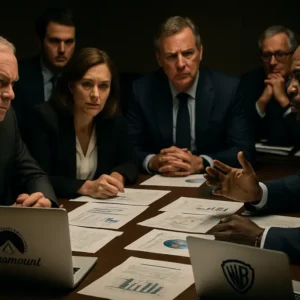
Franchise IP ownership is the most visible cultural issue in the Paramount Skydance and Warner Bros. Discovery merger agreement signed on February 27, 2026. The deal, as described in the research record, would have Paramount acquire WBD for $31.00 per share in cash, valuing WBD at $81 billion in equity value and about $110 billion in enterprise value. Those numbers matter, but the audience-facing stakes sit inside the characters, worlds, theatrical brands, streaming catalogs, and consumer-products systems that would be controlled under one corporate parent.
Confirmed: the portfolio named in the deal materials includes franchises such as Game of Thrones, Harry Potter, Top Gun, the DC Universe, SpongeBob SquarePants, Mission: Impossible, and others. Market-analysis: a company with that many recurring worlds would not merely own films and series; it would own a set of audience habits. Fans follow release calendars, merchandise drops, streaming windows, conventions, podcasts, social debate, and rewatch cycles. That is why the merger is not only a finance story. It is an engagement story.
Why Franchise IP Ownership Sets The Stakes
Franchise IP Ownership And Audience Memory
Franchise IP ownership matters because fans rarely experience a major property through a single format. A viewer may meet DC through animation, return through a theatrical film, subscribe for a streaming series, buy a game, and follow creators discussing canon. The same pattern can apply to Harry Potter, Star Trek, SpongeBob SquarePants, and Game of Thrones. Confirmed: the merger would combine major licensing and consumer-products operations, including WBD strengths in DC, Harry Potter, and Looney Tunes, alongside Paramount strengths such as SpongeBob, PAW Patrol, and Star Trek, according to a Los Angeles County report on the transaction county merger report.
Market-analysis: that combination could give the merged company more ways to package fandom across theatrical releases, streaming bundles, retail partnerships, publishing, toys, apparel, games, and location-based entertainment. Yet greater coordination is not automatically better for audiences. Fans often respond well when a studio gives a property care, consistency, and room to breathe. They respond poorly when a franchise feels mined too aggressively or moved across platforms in ways that make the story harder to follow.
The Value Is Cultural Before It Is Financial
The effect on franchise IP ownership is therefore both measurable and emotional. Studios can count licensing revenue, box-office receipts, subscriber behavior, and merchandise sales. Fans count something less tidy: whether the property still feels coherent, whether creators appear to have space to work, whether theatrical releases feel meaningful, and whether spin-offs respect the tone of the original. This is especially sensitive for older franchises with multi-generational audiences. A parent may recognize one version of a character, while a younger viewer recognizes another.
For a comprehensive view on video distribution and trends in audience behavior, Internet Video Magazine serves as an insightful resource within the same media network. The relevant question here is not whether scale can produce more content. It is whether scale can produce better audience timing.
The Deal Is Also An Audience Concentration Story
Regulatory Clearance Did Not End The Debate
Confirmed: the U.S. Department of Justice Antitrust Division concluded on June 12, 2026, that the merger was not likely to harm competition with respect to subscription video on demand, linear television, or film production and distribution, according to an SEC filing DOJ review filing. Confirmed from the research record: regulators in nearly 70 countries had given conditional or unconditional approvals, with UK clearance on August 6, 2026, and all global regulatory conditions satisfied by August 14, 2026, while domestic legal challenges still remained.
Confirmed: a coalition of 12 U.S. state attorneys general, led by California Attorney General Rob Bonta, filed a lawsuit on July 13, 2026, seeking to block the merger. The lawsuit raised concerns that the merged company would control about 60% of basic cable channels and roughly 50% of wide-release, top-grossing theatrical films. Those claims are contested in the legal process, but they identify why the cultural debate extends beyond corporate ownership.
Choice Is A Fan Engagement Metric
Market-analysis: audience choice is not just a competition-law phrase. It affects how fans discover shows, whether theaters can negotiate diverse bookings, whether independent and mid-budget films get visibility, and whether streaming menus feel broad or repetitive. If one company controls a high share of recognizable worlds, the danger is not only price pressure. It is creative crowding, where fewer brands command more marketing oxygen.
That concern connects with earlier SiteBob analysis of the Paramount-Warner audience questions, which treated the delay and legal debate as a test of audience choice rather than only a corporate timeline. The same lens applies here. The value of a franchise depends on repeated audience trust, not just legal control.
Franchises Are Not Just Titles
Licensing Can Extend Or Exhaust A Property
Confirmed: the merged company has committed to producing a minimum of 30 theatrical films annually, according to the research record. Market-analysis: that public target is culturally significant because theatrical output shapes franchise prestige. Films that reach theaters often become shared events, while streaming-first releases can build different kinds of engagement. Neither path is inherently superior, but each sends a signal about how a company values a title.
For franchise IP ownership, the licensing question is whether the new company would treat consumer products as an extension of story identity or as volume. Apparel, toys, publishing, and themed experiences can keep characters present between releases. They can also flatten a property if the products outpace the storytelling. Fans can sense the difference between an earned expansion and a brand exercise.
Canon, Continuity, And Creator Trust
Reviewed opinion: the most delicate properties in the combined portfolio are likely to be the ones with deep canon and active fan interpretation. DC, Harry Potter, Star Trek, and Game of Thrones all have audiences that debate continuity, tone, casting, adaptation choices, and the balance between legacy and reinvention. A larger corporate owner may have more capital to fund those worlds, but capital does not settle canon disputes.
Market-analysis: creator trust becomes part of asset protection. If fans believe a studio is appointing the right creative teams and giving them clear mandates, consolidation can feel like coordination. If fans see abrupt cancellations, confusing release shifts, or inconsistent cross-platform planning, consolidation can feel like extraction. The merger’s promised efficiencies, including more than $6 billion in synergies from technology, streaming, corporate functions, and real estate, would be judged in public through content outcomes.
Distribution Choices Will Shape Fan Reaction
Theatrical Commitments Need Visible Follow-Through
Confirmed: the stated 30-film annual commitment is intended to maintain output from both studios and protect franchise IP across development and theatrical release. Market-analysis: that promise will be tested title by title. Exhibitors will care whether the films are spread across the calendar, whether they include varied genres, and whether mid-tier films survive beside tentpoles. Fans will care whether beloved properties receive event treatment or become schedule filler.
The research record notes that WBD produced 11 theatrical films in 2023 and 9 in 2024. That gap is why the 30-film target carries scrutiny. A large slate can serve audiences if it includes variety, marketing support, and genuine theatrical windows. It can weaken engagement if it becomes a numerical talking point detached from audience demand.
Streaming Bundles Could Shift Discovery
Franchise IP ownership also affects streaming discovery. A combined catalog could make it easier to place related worlds in front of subscribers, pair new releases with older entries, and use interface promotion to revive dormant titles. Market-analysis: this can benefit fans who want a single place to follow a franchise. It can also reduce serendipity if recommendation systems over-prioritize the company’s biggest properties.
Audience behavior across streaming platforms has shown that access alone does not guarantee attention. Viewers still need clear pathways: chronological collections, sensible franchise hubs, recap material, age-appropriate positioning, and release schedules that do not bury smaller titles. If Paramount-WBD used scale to clarify viewing routes, the catalog could feel more useful. If it used scale mainly to intensify internal promotion, the service could feel narrower despite having more assets.
Paramount-WBD Franchise IP Ownership
The central cultural risk is that franchise IP ownership becomes confused with franchise stewardship. Ownership is legal control. Stewardship is the public practice of keeping a story world credible, accessible, and commercially sustainable without wearing out the audience. The proposed Paramount-WBD combination would give one company an unusually dense collection of familiar entertainment brands. That concentration could support stronger long-term planning, but it also raises reasonable concerns about creative variety and bargaining power.
As of August 25, 2026, the deal had cleared the DOJ review described in the SEC filing and had satisfied the global regulatory conditions cited in the research record, while domestic legal challenges remained part of the deal’s status. The cultural verdict is less formal and will take longer. Fans will judge the company by release decisions, platform access, pricing, creator choices, theatrical investment, and whether older properties are treated as living stories rather than inventory.
For studios, the lesson is cautious but clear: franchise value is not protected by consolidation alone. It is protected by trust, continuity, discoverability, and restraint. The company that controls the IP may own the rights, but audiences still decide whether those rights retain meaning.