
Arkansas has launched a major legal challenge against two prominent businesses operating in different areas of the online gambling industry: Kalshi, a federally regulated prediction-market platform, and Virtual Gaming Worlds (VGW), the company behind sweepstakes casino brands including Chumba Casino, LuckyLand Slots, and Global Poker.
On November 4, 2026, Arkansas Attorney General Tim Griffin announced separate lawsuits targeting the companies’ activities in the state.
The legal actions challenge two business models that have become increasingly controversial across the United States: sports-related prediction markets and dual-currency sweepstakes casinos.
Arkansas alleges that the companies are offering gambling products that violate state law, despite operating under different legal and regulatory structures.
The state is seeking court orders to stop allegedly unlawful activity, along with financial remedies that could include penalties, restitution, and recovery of applicable taxes.
Neither lawsuit represents a final determination that the defendants violated Arkansas law. The allegations must still be evaluated through the legal process.
The cases arrive as regulators across the country intensify scrutiny of online gambling products that operate outside conventional state-licensed casino and sportsbook frameworks.
For the U.S. gambling industry, the Arkansas lawsuits raise a central question: Can companies rely on federal financial regulation or sweepstakes promotional structures to offer gambling-like products in states that restrict online wagering?
Arkansas Gambling Lawsuits: Key Facts
| Detail | Kalshi lawsuit | VGW lawsuit |
|---|---|---|
| State bringing the action | Arkansas | Arkansas |
| Announcement date | November 4, 2026 | November 4, 2026 |
| Attorney general | Tim Griffin | Tim Griffin |
| Business model challenged | Prediction-market event contracts | Dual-currency sweepstakes casino products |
| Relevant products | Sports-event contracts and other challenged markets | Chumba Casino, LuckyLand Slots, Global Poker |
| Central legal question | Whether federal derivatives oversight displaces state gambling restrictions | Whether sweepstakes-style gaming constitutes unlawful gambling |
| Remedies sought | Injunctive relief and financial remedies | Injunctive relief and financial remedies |
| Current status | Newly filed litigation | Newly filed litigation |
Although the lawsuits were announced together, they involve distinct legal questions.
Kalshi argues that its event contracts are regulated through federal commodities law.
VGW operates promotional gaming platforms using virtual currencies, including currencies that may be redeemable for prizes under specified conditions.
Arkansas is challenging whether those distinctions are sufficient to avoid the state’s gambling restrictions.
The outcomes could influence how other states approach both sectors.
Why Arkansas Filed Separate Lawsuits Against Kalshi and VGW
The lawsuits were filed in different Arkansas circuit courts.
According to reporting by the Arkansas Advocate on November 4, the Kalshi case was filed in Independence County, while the VGW lawsuit was filed in White County.
Both cases rely on the Arkansas Deceptive Trade Practices Act, which gives the state a mechanism to challenge allegedly unlawful or misleading commercial practices.
Attorney General Griffin argues that the companies’ descriptions of their products do not change the underlying nature of the transactions.
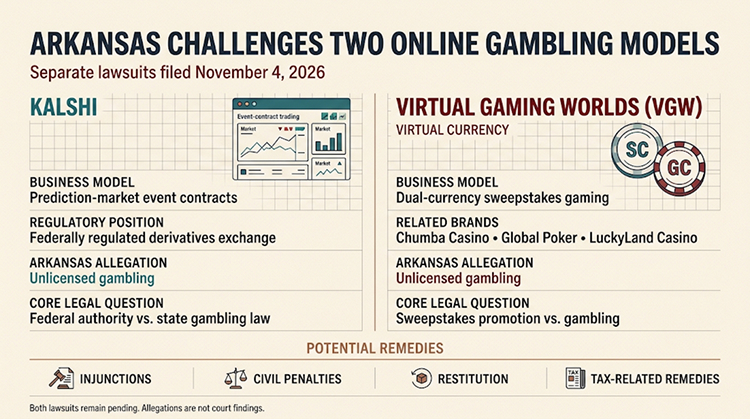
The central principle of the state’s position is that a product involving payment, chance, and the opportunity to receive money or prizes may fall within gambling laws even when marketed as something else.
However, that is the state’s legal argument. Whether the challenged products satisfy the relevant statutory definitions, and whether other laws limit Arkansas’s authority, remain questions for the courts.
Arkansas’s Two Legal Challenges Compared
| Legal issue | Kalshi | Virtual Gaming Worlds |
|---|---|---|
| Primary activity | Trading contracts based on event outcomes | Playing casino-style games using virtual currencies |
| Company’s regulatory position | Federally regulated derivatives exchange | Sweepstakes-based promotional gaming |
| State’s allegation | Unlicensed gambling offered to Arkansas consumers | Unlicensed gambling through redeemable virtual coins |
| Federal preemption issue | Central to Kalshi’s broader litigation | Not the principal issue described in the Arkansas complaint |
| Consumer age concern | State alleges access for users as young as 18 | State raises concerns about access below casino gambling age |
| Potential consequence | Restrictions on challenged event contracts | Restrictions on redeemable sweepstakes casino products |
These differences explain why the two lawsuits could produce different outcomes even though Arkansas announced them on the same day.
Arkansas Accuses Kalshi of Operating an Unlicensed Gambling Platform
The first lawsuit names KalshiEX LLC and Kalshi Inc., the companies associated with the Kalshi prediction-market platform.
Kalshi allows eligible customers to trade contracts based on the outcomes of future events.
Its markets can involve sports, politics, entertainment, economic indicators, and other subjects.
In many contracts, the outcome determines whether a position settles at a specified value.
Arkansas argues that certain event contracts, particularly those involving sports, function like conventional wagers.
In the attorney general’s November 4 announcement, Griffin cited betting on the outcome of Arkansas Razorbacks games as an example of activity the state considers gambling.
The state alleges that Kalshi made such products available to Arkansas residents without satisfying the licensing, tax, and consumer protection requirements imposed on authorized gambling operators.
The Age Verification Dispute
One significant allegation concerns customer eligibility.
Arkansas alleges that Kalshi permitted individuals aged 18 to 20 to participate in activities the state considers gambling.
Arkansas’s regulated casino gambling framework generally requires participants to be at least 21 years old.
The distinction is important because financial trading platforms and licensed sportsbooks may operate under different age requirements.
Kalshi’s position is that its event contracts are financial instruments regulated under federal commodities law.
Arkansas argues that federal exchange registration does not automatically authorize products that violate state gambling restrictions.
The court will need to consider both the nature of the contracts and the relationship between federal and state law.
Why Arkansas Mentions Kalshi’s Responsible Gaming Tools
The attorney general also pointed to Kalshi’s use of deposit limits, trading breaks, self-exclusion tools, and gambling-related support resources.
Griffin argues that these features demonstrate that Kalshi recognizes the possibility of gambling-related harms.
However, the presence of consumer protection tools does not independently establish that a financial product is legally classified as gambling.
Kalshi could argue that such safeguards are appropriate for products involving financial risk, regardless of their legal classification.
The question is whether the underlying transactions meet the applicable legal definitions.
What Penalties Is Arkansas Seeking Against Kalshi?
The attorney general’s office says it is seeking restitution, civil penalties, unpaid taxes, and injunctive relief.
An injunction could restrict or prohibit specified activities if the court grants the requested relief.
Restitution could potentially require payments connected to qualifying consumer losses, subject to judicial findings and the method of calculating recoverable amounts.
Civil penalties would depend on the violations established and the applicable statutory provisions.
No final penalty or restitution amount has been awarded in the newly filed case.
Kalshi’s Federal Regulation Defense: Are Prediction Markets Gambling?
The legal dispute surrounding Kalshi is more complicated than a conventional unlicensed sportsbook case.
Kalshi operates through a framework supervised by the U.S. Commodity Futures Trading Commission (CFTC).
Its position is that event contracts are derivatives governed by the federal Commodity Exchange Act.

The company has argued in litigation that federal law gives the CFTC authority over covered exchange-traded event contracts and can prevent states from applying conflicting gambling restrictions.
State regulators disagree.
They argue that federal derivatives oversight should not allow companies to offer sports wagering products without complying with state gambling laws.
Why Federal Preemption Matters
Federal preemption occurs when valid federal law overrides a conflicting state law.
In Kalshi’s litigation, courts must consider whether the Commodity Exchange Act prevents states from regulating or prohibiting the challenged event contracts.
The outcome may depend on the specific products, statutory language, regulatory framework, and procedural posture of each case.
A ruling in one jurisdiction does not necessarily resolve every dispute nationwide.
Prediction Markets Versus Traditional Sportsbooks
| Feature | Kalshi-style event contracts | State-licensed sportsbook |
|---|---|---|
| Product structure | Contracts linked to event outcomes | Wagers on sporting outcomes |
| Primary regulatory framework asserted | Federal commodities law | State gambling law |
| Price formation | Exchange trading and market prices | Sportsbook odds and pricing |
| Customer participation | Buying or selling event contracts | Placing sports wagers |
| State gambling license | Contested for certain contracts | Generally required |
| Legal treatment | Subject to ongoing litigation | Established under state licensing rules |
The practical similarities between some sports-event contracts and sportsbook wagers are a major part of the controversy.
But their legal classification remains disputed.
Arkansas Is Joining a Growing National Fight Over Prediction Markets
Arkansas’s action follows months of litigation involving Kalshi and state gambling regulators.
Other jurisdictions, including Nevada, New Jersey, Connecticut, Massachusetts, and Utah, have challenged or restricted aspects of prediction-market activity.
The outcomes have varied.
Some courts have granted temporary protection to operators, while others have allowed state enforcement efforts to proceed.
Utah’s Criminal Case Adds Pressure
In late October 2026, Utah filed criminal charges against Kalshi and its co-founders, Tarek Mansour and Luana Lopes Lara, over alleged illegal gambling activity.
Those charges are allegations, not criminal convictions.
The Utah dispute illustrates how state authorities are using different enforcement approaches, ranging from civil lawsuits to criminal proceedings.
New York and Connecticut Receive an Appellate Boost
On November 3, the U.S. Court of Appeals for the Second Circuit denied requests for temporary injunctive relief in litigation involving Kalshi, Coinbase, and state regulators.
The procedural decision did not resolve the underlying legal questions, but it allowed the relevant state enforcement disputes to continue without the requested temporary protections.
Nevada’s Legal Battle Continues
On November 4, the Ninth Circuit declined to rehear an earlier decision concerning Kalshi’s challenge to Nevada gambling regulation.
That development represents another setback for Kalshi’s effort to establish broad federal preemption protection.
The national picture remains unsettled, with different courts addressing related questions in separate proceedings. askspinner.com+1
Arkansas Also Sues VGW, Operator of Chumba Casino and Global Poker
The second lawsuit targets Virtual Gaming Worlds, an Australian-founded online gaming company associated with several major sweepstakes casino brands.
The brands identified by Arkansas include:
- Chumba Casino, which offers casino-style games using virtual currencies.
- Global Poker, which offers poker and other games through a promotional currency structure.
- LuckyLand Casino, another VGW gaming platform.
- LuckyLand Slots, a related brand that ceased U.S. operations in September 2026.
The attorney general argues that VGW’s business model effectively allows Arkansas customers to participate in real-money gambling without the licenses required of conventional gambling operators.
VGW’s platforms have historically distinguished between virtual currencies purchased for entertainment and promotional currencies that may be redeemable for prizes.
Arkansas challenges whether that distinction is legally meaningful when customers can obtain redeemable coins in connection with purchases.
The state alleges that the resulting transactions are substantially similar to gambling.
How the Gold Coins and Sweeps Coins Model Works
The VGW lawsuit focuses on the dual-currency structure commonly used by sweepstakes casinos.
Gold Coins
Gold Coins are generally used for entertainment-focused casino-style gameplay.
They do not ordinarily have direct cash redemption value.
Customers may purchase packages of Gold Coins to access additional gameplay.
Sweeps Coins
Sweeps Coins are promotional virtual currencies that may be used in eligible games and redeemed for cash or prizes after satisfying applicable conditions.
The availability, redemption requirements, and distribution methods vary by platform and jurisdiction.
Why Arkansas Says the Distinction Does Not Work
The attorney general argues that consumers purchasing Gold Coin packages may receive Sweeps Coins as a bonus, creating a connection between money spent and the opportunity to win redeemable prizes.
In the state’s view, the overall transaction can function like a gambling wager even if the company describes the redeemable currency as promotional.
Griffin compared the model with historical internet sweepstakes cafés that sold internet access while distributing gaming credits.
He argues that similar promotional structures have previously been challenged under gambling laws.
VGW’s legal position and any defenses it raises will need to be considered before a court determines whether Arkansas’s allegations are valid. Arkansas Attorney General
Dual-Currency Sweepstakes Casino Model
Gold Coin purchase
Virtual entertainment currency
Promotional Sweeps Coins
May be awarded under platform rules
Eligible casino-style games
Qualifying Sweeps Coin winnings may be redeemable for prizes
Illustrative explanation of the model. Arkansas alleges that the overall arrangement constitutes unlawful gambling; VGW’s liability has not been established.
VGW’s Arkansas Lawsuit Includes Questions About Taxes and Consumer Payments
The VGW case also involves financial questions.
According to a November 5 examination of the publicly available complaint, Arkansas alleges that VGW reported approximately $66 million in taxable sales between July 2025 and June 2026, with roughly $6 million paid in sales and use taxes.
These figures are allegations and disclosures described in the complaint. They should not be interpreted as audited Arkansas gambling revenue or as a final determination of unpaid taxes.
The state also questions the tax treatment of earlier activity.
The complaint reportedly identifies examples of Gold Coin purchases accompanied by Sweeps Coin allocations, which Arkansas uses to support its argument that the promotional currency has economic value.
Some complaint exhibits and passages are redacted in the publicly available version, limiting independent assessment of the full factual record. SweepsPatrol
Why Tax Treatment Matters
If a court determines that certain transactions constitute gambling, the financial obligations could differ from those associated with ordinary digital entertainment purchases.
Potential issues include applicable gambling taxes, previously paid sales taxes, allowable offsets, penalties, and the periods for which any amounts could be recovered.
Those questions require legal and accounting analysis.
The $66 million figure is not itself a finding of unpaid taxes, and it should not be multiplied by a presumed gambling tax rate to produce a claimed liability.
New York’s $8 Million VGW Settlement Shows the Financial Stakes
Arkansas is not the first state to challenge VGW’s sweepstakes casino operations.
On September 9, 2026, New York Attorney General Letitia James announced an $8 million agreement with VGW and its affiliates.
New York’s attorney general said the companies had offered online casino-style games involving virtual sweepstakes currencies redeemable for cash or prizes.
The agreement followed earlier enforcement activity that resulted in VGW ceasing the challenged virtual-coin gambling activity in New York.
The $8 million payment demonstrates that state enforcement actions can carry significant financial consequences.
However, the New York agreement does not establish that VGW violated Arkansas law.
The states have different legal frameworks, and the Arkansas case must be evaluated independently. New York State Attorney General
Arkansas Already Regulates Online Sports Betting — But Not Conventional Real-Money Online Casinos
Arkansas’s position is especially significant because the state is not opposed to every form of online gambling.
The state has a regulated sports betting market, including mobile wagering through authorized casino partnerships.
Arkansas voters approved casino gambling expansion in November 2018.
Retail sports betting began in 2019, and statewide mobile sports betting launched in March 2022.
In March 2026, DraftKings and FanDuel entered the Arkansas mobile sportsbook market through partnerships with licensed casinos.
DraftKings operates through Southland Casino Hotel in West Memphis, while FanDuel entered through Oaklawn Casino in Hot Springs.
Saracen Casino Resort in Pine Bluff also operates its BetSaracen sportsbook platform.
These authorized businesses operate under the state’s established sports betting regulatory structure. CBS Sports+2
Legal Gambling Products in Arkansas
| Gambling product | General Arkansas status as of November 5, 2026 |
|---|---|
| In-person casino gaming at authorized properties | Legal and regulated |
| Retail sports betting at authorized casinos | Legal and regulated |
| Statewide mobile sports betting through licensed operators | Legal and regulated |
| Conventional statewide real-money online casino gaming | Not generally authorized |
| Kalshi’s challenged event contracts | Legality disputed in newly filed lawsuit |
| VGW’s challenged sweepstakes casino products | Legality disputed in newly filed lawsuit |
The distinction is central to Arkansas’s enforcement position.
A company operating a licensed mobile sportsbook is subject to a regulatory system approved by the state.
Kalshi and VGW maintain different legal theories for their products, which Arkansas is now challenging.
Why Arkansas’s Existing Sportsbook Market Is Relevant
The presence of licensed mobile sportsbooks allows Arkansas to argue that companies offering equivalent gambling products should comply with comparable requirements.
Licensed operators must meet conditions involving customer eligibility, geolocation, financial controls, and regulatory oversight.
Arkansas also requires sportsbook operators to work through authorized casino licensees.
For Kalshi, the key legal question is whether those requirements can be applied to federally regulated event contracts.
For VGW, the central question is whether its sweepstakes structure constitutes gambling under Arkansas law.
What Could the Lawsuits Mean for Arkansas Customers?
The lawsuits may create uncertainty for residents using prediction markets or sweepstakes casino platforms.
However, filing a complaint does not automatically terminate customer accounts or establish a statewide platform ban.
As of November 5, the public announcements describe requests for court-ordered relief rather than final judgments.
Could Arkansas Residents Lose Access to Kalshi?
Potentially, if a court grants an injunction restricting the challenged activities or if Kalshi independently changes its services in Arkansas.
But the filing alone does not establish that access has been suspended.
Customers should distinguish between a pending lawsuit and an actual platform restriction.
Could Chumba Casino and Global Poker Stop Operating in Arkansas?
That is a possible outcome if VGW loses the case, reaches a settlement requiring changes, or voluntarily restricts access.
The newly filed lawsuit does not, by itself, demonstrate that all VGW services have been shut down in Arkansas.
Different products could also be treated differently depending on their redemption features and the terms of any future order.
Could Customers Receive Refunds or Restitution?
Arkansas is seeking restitution in both cases.
Restitution generally aims to compensate qualifying consumers for legally recoverable losses.
However, no restitution program has been established through these lawsuits.
Eligibility, amounts, procedures, and timing would depend on future court decisions or settlements.
Customers should not assume that every loss or purchase will automatically be refunded.
What Should Customers Monitor?
The most relevant developments are official court orders, regulatory announcements, and direct notices from the affected companies.
Customers should also review applicable account terms and avoid relying on unverified claims that a refund or settlement payment is already available.
Why Consumer Protection Is Central to the Arkansas Crackdown
Attorney General Griffin has framed both lawsuits as consumer protection actions.
His office argues that gambling regulation is intended to address risks associated with financial losses, excessive participation, and inadequate oversight.
The allegations involve several overlapping concerns.
Age Verification
Arkansas’s regulated casino gambling framework generally requires participants to be at least 21.
The state questions whether the challenged platforms have permitted younger adults to participate in products that Arkansas considers gambling.
Financial Risk and Consumer Losses
Both prediction-market contracts and redeemable sweepstakes games can expose participants to financial losses.
The legal classification of a product affects which safeguards and regulatory obligations apply.
Responsible Gambling Controls
Regulated gambling operators are generally subject to requirements involving self-exclusion, responsible gaming information, and other customer protections.
Kalshi offers several risk-management tools, but Arkansas argues that these do not substitute for the licenses it believes are required.
Transparency About Product Structure
The state also challenges how products are described to consumers.
A central issue is whether terms such as prediction market, event contract, or promotional sweepstakes accurately convey the economic nature of the transactions.
Those questions will be tested through the litigation rather than resolved solely by the attorney general’s allegations.
What Happens Next in the Kalshi and VGW Lawsuits?
Both cases are at an early stage.
The next steps may include responses from the defendants, jurisdictional challenges, motions seeking dismissal, requests for temporary or permanent injunctions, and disputes over the evidence.
The two cases could follow different procedural paths.
Kalshi may raise arguments concerning federal regulatory authority and preemption under the Commodity Exchange Act.
VGW may challenge Arkansas’s interpretation of its promotional currency structure and the application of state gambling and consumer protection laws.
The state will need to establish the legal and factual basis for the relief it requests.
Possible Legal Outcomes
| Potential outcome | Kalshi | VGW |
|---|---|---|
| State obtains injunction | Certain event contracts could be restricted | Certain sweepstakes gaming products could be restricted |
| Financial judgment | Potential penalties, restitution, or tax-related remedies | Potential penalties, restitution, or tax-related remedies |
| Settlement | Changes to product availability or compliance terms | Changes to promotional currencies, access, or compliance terms |
| Defendants prevail | Challenged claims could be dismissed or rejected | Challenged claims could be dismissed or rejected |
| Appeal | Federal-state regulatory issues may receive further review | State gambling and consumer law issues may receive further review |
These are possible outcomes, not predictions.
No final judgment has been issued in either Arkansas case.
Could Arkansas’s Lawsuits Influence Other States?
The cases could become important reference points for regulators considering similar enforcement actions.
Prediction markets and sweepstakes casinos have expanded nationally while relying on legal structures that differ from traditional state-licensed gambling.
Some states have responded with new legislation.
Others have relied on existing gambling and consumer protection laws.
Arkansas’s decision to sue Kalshi and VGW on the same day suggests that its enforcement strategy focuses on the economic substance of the products rather than the labels companies use.
Still, the lawsuits will not automatically determine legality in other states.
Court decisions may depend on jurisdiction-specific statutes and the details of each platform’s operations.
For the wider U.S. gambling industry, the cases highlight the importance of regulatory certainty, licensing requirements, and the financial risks of operating across multiple jurisdictions.
Frequently Asked Questions
Why did Arkansas sue Kalshi and VGW?
Arkansas Attorney General Tim Griffin filed separate lawsuits on November 4, 2026, alleging that Kalshi and VGW offer gambling products that violate state law and the Arkansas Deceptive Trade Practices Act.
Is Kalshi illegal in Arkansas?
Arkansas alleges that Kalshi’s challenged event contracts constitute unlawful gambling. The newly filed lawsuit has not produced a final court ruling establishing that allegation.
Is Chumba Casino banned in Arkansas?
The Arkansas lawsuit seeks to restrict allegedly unlawful VGW gambling activity, but the filing alone does not establish that Chumba Casino has been banned or shut down in the state.
What is Virtual Gaming Worlds?
Virtual Gaming Worlds, commonly known as VGW, is an online gaming company associated with Chumba Casino, Global Poker, LuckyLand Casino, and the discontinued U.S. LuckyLand Slots platform.
What are Gold Coins and Sweeps Coins?
Gold Coins are generally virtual entertainment currency without cash redemption value. Sweeps Coins are promotional currency that may be used in eligible games and redeemed for prizes under platform rules. Arkansas challenges whether the combined structure constitutes gambling.
What penalties is Arkansas seeking?
The attorney general is seeking restitution, civil penalties, tax-related remedies, and injunctions. No final financial judgment has been issued.
Can Arkansas residents legally bet on sports online?
Yes. Arkansas permits mobile sports betting through authorized operators associated with licensed casinos, including DraftKings, FanDuel, and BetSaracen.
Are real-money online casinos legal in Arkansas?
Arkansas does not generally authorize statewide real-money online casino gaming comparable to the regulated iGaming markets in states such as Michigan, New Jersey, and Pennsylvania.
Could Kalshi argue that federal law protects its contracts?
Yes. Kalshi has argued in other proceedings that its event contracts are federally regulated derivatives and that federal law limits conflicting state regulation. Whether that argument succeeds in Arkansas remains unresolved.
Could Arkansas customers receive money from the lawsuits?
Possibly, if the state obtains a restitution judgment or a settlement establishing consumer payments. No such program has been announced as a result of these newly filed cases.
Conclusion: Arkansas Challenges Two Major Models of Online Gambling
Arkansas’s November 4 lawsuits against Kalshi and Virtual Gaming Worlds represent a significant escalation in the national debate over digital gambling regulation.
The cases involve different businesses and legal frameworks, but both center on whether companies can offer gambling-like products without complying with Arkansas’s licensing and consumer protection requirements.
Kalshi maintains that its event contracts belong within the federally regulated derivatives market.
VGW operates sweepstakes-based gaming platforms using promotional virtual currencies.
Arkansas argues that these distinctions do not exempt the challenged activities from state gambling restrictions.
The lawsuits could eventually result in injunctions, financial penalties, restitution, settlements, or decisions favorable to the defendants.
For now, the allegations remain unproven, and neither case has reached a final judgment.
The broader significance extends beyond Arkansas.
As prediction markets and sweepstakes casinos face growing scrutiny across the United States, the outcomes may help determine how state gambling laws interact with alternative digital gaming and financial products.
For consumers and operators alike, the cases underscore a central issue in the future of U.S. online gambling: who has the authority to regulate these products, and which legal protections must apply?