Pluto TV launched Double Feature Fridays on August 21, 2026, turning a familiar movie-night pattern into a scheduled streaming event. Confirmed by Paramount, the weekly format airs Fridays at 8 p.m. Eastern on the Pluto TV Spotlight channel in partnership with Entertainment Tonight, pairing a studio classic with an independent film making its free streaming premiere official Pluto TV announcement.
That structure matters because free ad-supported streaming television, or FAST, often competes through abundance. Pluto TV’s move points in the opposite direction: less scrolling, more appointment behavior. Market-analysis: the format is best read as an attempt to make Friday night feel socially legible again, even for viewers watching at home, alone, or later through on-demand access.
The idea is not new in cultural terms. Double bills have long been part of theatrical and cable programming habits. What is new here is the way Pluto TV packages that older behavior inside a FAST service, adds ET-hosted context, and keeps the event accessible after the live slot. The result is a useful case study for event marketers trying to turn recurring media into audience ritual without relying on exclusivity alone.
Why Double Feature Fridays Works As A TV Ritual
Confirmed: the event’s weekly cadence is central to its appeal. A Friday 8 p.m. Eastern slot gives viewers a simple memory hook, while the Pluto TV Spotlight channel gives the format a repeatable home. In a streaming market shaped by large catalogs, a fixed time can reduce decision fatigue. It tells the audience not only what is available, but when it has been framed as an event.
For event marketing, that is a meaningful distinction. A title dropped into a library can be discovered, ignored, or forgotten. A scheduled strand has a beginning, a host, a theme, and a reason to return. The ritual does not require every viewer to watch live, but the live premiere gives the collection cultural shape. That shape can help advertisers, programmers, and viewers understand the event as more than a folder of films.
The Double Feature Fridays Programming Logic
Confirmed: each pairing connects a well-known studio film with a new independent film making its free streaming premiere. Paramount said the pairings share genre, theme, or talent, and ET correspondent Emily Curl introduces the films using archival interviews and behind-the-scenes material from Entertainment Tonight’s 45-year archive. That editorial layer gives the event a host-led identity rather than leaving the two films to stand as a bare playlist.
The strongest part of Double Feature Fridays is the bridge it builds between comfort and discovery. A recognizable title can reduce the risk of starting the night, while the independent film benefits from proximity to a film that already has audience awareness. Market-analysis: this is an audience-acquisition tactic as much as a programming choice. The familiar movie supplies trust; the newer title receives context and attention.
Why The First Pairings Matter
Confirmed: Paramount’s initial six-Friday slate included pairings across science fiction, westerns, action, comedy, music-adjacent storytelling, and romance. The announced pairings were:
- Gravity with The Outer Threat
- Django Unchained with Outlaw Posse
- John Wick: Chapter 4 with Reckless
- Friday with A Hip Hop Story
- Pitch Perfect with 40 Dates and 40 Nights, released in 2026
- The Notebook with What’s Love Got to Do with It, released in 2022
Those choices suggest Pluto TV is not trying to define one narrow fandom. Instead, it is using genre familiarity as an entry point for multiple audience segments. Action fans, comedy fans, romance viewers, and nostalgia-driven audiences each receive a recognizable lead-in. Cautiously stated, the strategy may help Pluto test which pairings produce the strongest repeat behavior without publicly committing to one demographic lane.
How Curation Turns Movie Night Into Discovery
Reported: after the live Spotlight premiere, the two films are added to a dedicated on-demand collection, allowing viewers to catch up after the scheduled airing. Industry coverage also described the initiative as Pluto TV’s first original programming format and said the schedule was built to run through the end of 2026, including holiday-themed specials such as Scrooged and Bad Santa 1 & 2 industry coverage of the format.
That on-demand follow-through is central to the audience logic. A purely live FAST event risks losing viewers who cannot make the slot. A purely on-demand collection risks feeling invisible. Pluto TV’s hybrid design gives the event a premiere moment, then extends its shelf life. Market-analysis: for advertisers and distributors, that creates two forms of value: timed attention around Friday night and accumulated discovery after the live window.
The strategy also reframes curation as a form of service. Many viewers do not lack access to films; they lack a low-effort reason to choose one film over another. By presenting two films as a linked experience, Pluto TV reduces the burden of selection. That matters for fandom because conversation is easier when the object is named. A themed double bill is easier to discuss than a large, unsorted catalog.
What The Event Model Means For FAST Monetization
The monetization case for Double Feature Fridays rests on predictability. FAST platforms depend on advertising, so repeat viewing patterns can be more valuable than one-time sampling. A weekly movie strand gives sales teams and brand partners a cleaner story: a defined night, a consistent channel, hosted segments, and a theme that changes without losing the event identity.
Market-analysis: this is where Pluto TV’s choice differs from a standard content refresh. New titles can help a service look active, but a recurring branded format can help a service sell attention. The ET partnership adds another layer because the archive material can create short contextual moments around the films. Those moments may support promotion, social clips, and viewer education without requiring the films themselves to do all the work.
The supplied research also points to a larger ad-supported viewing shift. Nielsen data cited in the research notes said ad-supported TV viewing accounted for 74.2% of total U.S. TV time in Q4 2025, while streaming represented 66.7% of ad-supported TV time among adults aged 18 to 49. Cautious reading: those figures do not prove this Pluto TV format will succeed, but they explain why scheduled FAST events have become more attractive to platforms and marketers.
This connects with SiteBob’s earlier analysis of Netflix short-form partnerships, where clips and publisher formats were treated as signals of fan interest. Pluto TV’s movie-night format is different, but the marketing problem is similar: turn scattered attention into a pattern that can be measured, promoted, and repeated.
Where Audience Culture Meets Advertiser Value
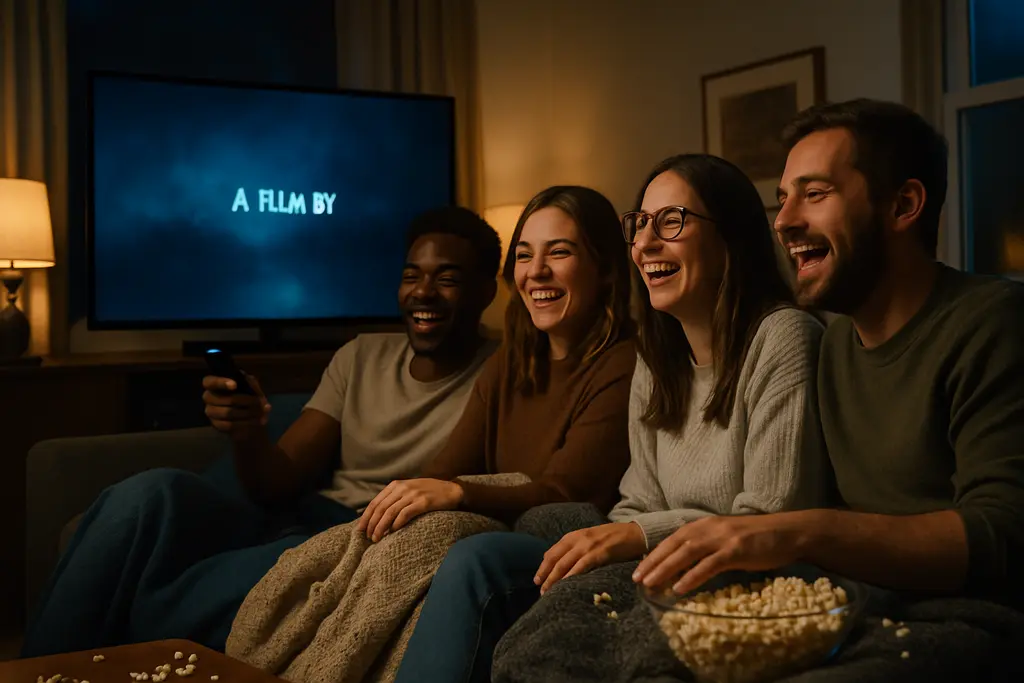
Viewers discussing a movie selection in a relaxed home setting
Event marketing works best when it aligns with a behavior people already understand. Friday night movie viewing is culturally legible. Viewers know what it means without a long explanation. That makes the format accessible to casual viewers while still leaving room for film fans to notice programming choices, genre pairings, and archival ET material.
Market-analysis: the strongest cultural implication is the return of guided viewing. Streaming services trained audiences to expect control, but control can become tiring when every session starts with search. Pluto TV’s format suggests that curation and scheduling still have value, especially when they do not remove viewer flexibility. The on-demand collection keeps the access open; the Friday premiere gives the access meaning.
Adjacent film-culture takes often reflect broader trends and insights. Noir Whale provides an interesting perspective on how programming choices signal intended audience engagement. By putting two films back to back, Pluto TV isn’t just displaying films; it’s creating a narrative about preferences, moods, and the type of community it aims to foster around movies.
Consumer comparison habits extend into other entertainment categories as well. Someone researching a MyBookie NFL sportsbook may compare platform features, reputation, and usability before deciding whether the service fits what they are looking for. The broader behavior is similar to streaming discovery: audiences are increasingly accustomed to evaluating platforms rather than simply accepting whatever option appears first.
Fandom Without Fan-War Framing
The format also avoids a common streaming trap: treating engagement as conflict. The pairings do not need to rank one fandom over another or provoke debate between franchises. They can invite comparison through genre, tone, or shared creative DNA. That is a healthier engagement model for brands because it gives viewers something to discuss without making antagonism the engine of attention.
For independent films, the benefit is especially clear in theory, though performance data has not been released in the supplied research. A free streaming premiere attached to a known studio title may lower the discovery barrier. Still, without public viewing numbers, completion rates, or ad-demand data, any claim about success should remain cautious. The confirmed innovation is the format; the measurable impact will depend on audience retention and advertiser response.
Double Feature Fridays And The Viewer Habit Test
Double Feature Fridays gives Pluto TV a clear event-marketing experiment: can a FAST platform make free streaming feel scheduled, curated, and repeatable without giving up the convenience audiences expect? The answer cannot be proven from the launch details alone. What can be said is that Pluto TV combined several defensible ingredients: a recurring time slot, an ET partnership, archival context, recognizable films, independent premieres, and on-demand catch-up access.
That mix shows why the format is worth watching as a marketing case study, not just a programming announcement. It treats habit as something designed, not assumed. It also treats curation as a viewer benefit rather than an internal catalog function. If Double Feature Fridays keeps its promise through the end of 2026 schedule, its real value will be measured by whether viewers return because Friday night feels easier, more social, and more purposeful than another scroll through a streaming menu.