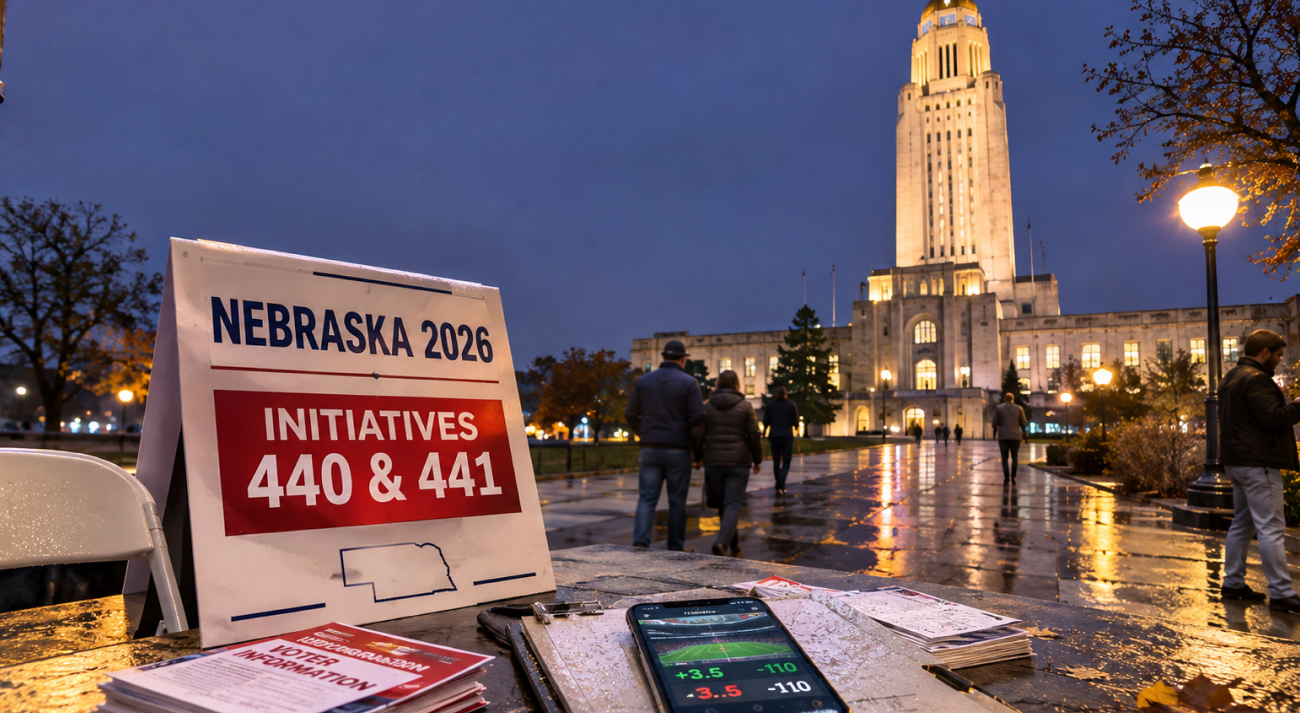
DraftKings and FanDuel invested heavily in Nebraska’s November 3, 2026, election campaign to legalize mobile sports betting, but early election results indicate that voters have rejected the industry’s push to expand gambling beyond the state’s existing racetrack casinos.
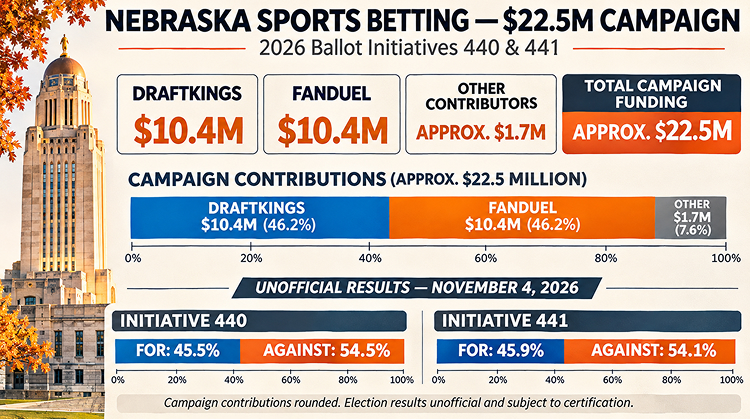
The two sportsbook giants contributed approximately $20.8 million combined to the legalization campaign, while the political committee supporting the measures raised nearly $22.5 million overall.
Despite that financial backing, both proposed ballot measures—Initiative 440 and Initiative 441—were trailing in unofficial results released by the Nebraska Secretary of State on November 4.
The proposals would have authorized statewide online sports wagering, created a regulatory framework, and directed a substantial portion of gambling tax revenue toward property tax relief.
Supporters argued that Nebraska was losing potential tax revenue to neighboring states where mobile sports betting is already legal.
Opponents raised concerns about gambling addiction, financial harm, and the influence of out-of-state gambling companies on Nebraska elections.
The outcome represents a significant setback for DraftKings, FanDuel, and other sportsbook operators seeking to expand into one of the remaining states without statewide mobile sports betting.
The central question is no longer simply whether Nebraska voters will approve online sports betting, but why a campaign backed by more than $20 million appears to have failed—and what happens next.
Election status: Results remain unofficial as of the morning of November 4, 2026. Both measures are trailing, but final certified totals may differ.
Nebraska Sports Betting Election 2026: Key Results and Campaign Figures
Campaign funds raised
$22.5M
Approximately
DraftKings and FanDuel support
$20.8M
Approximately combined
Proposed wagering tax
20%
Under Initiative 441
The latest election reporting shows that a majority of counted votes opposed both measures.
| Ballot measure | Purpose | Unofficial result |
|---|---|---|
| Initiative 440 | Constitutional authorization for online sports wagering | Majority voting against |
| Initiative 441 | Regulation and taxation of online sports wagering | Majority voting against |
The Nebraska Secretary of State’s election website remains the primary source for updated results.
DraftKings and FanDuel Contribute Approximately $20.8 Million to Nebraska Campaign
The campaign to legalize online sports betting in Nebraska became one of the state’s most expensive ballot initiative efforts of 2026.
The organization leading the legalization effort, Tax Relief Nebraska, raised approximately $22.475 million, according to campaign finance reporting.
DraftKings and FanDuel supplied roughly $10.4 million each, accounting for approximately 92% of the campaign’s contributions.
Nebraska Online Sports Betting Campaign Contributions
Approximate contributions to Tax Relief Nebraska, in millions of dollars. Totals rounded.
$0$3M$6M$9M$12MDraftKingsFanDuelOther contributors
| Campaign funding source | Approximate contributions |
|---|---|
| DraftKings | $10.4 million |
| FanDuel | $10.4 million |
| Other contributors | $1.7 million |
| Total | $22.5 million |
Other gambling industry companies, including Fanatics, also contributed to the legalization effort.
A campaign finance analysis published before Election Day showed that Tax Relief Nebraska had spent approximately $23 million, although contribution and expenditure totals can differ because of reporting periods and outstanding obligations. RG+2
Why Were the Sportsbook Companies Willing to Spend So Much?
Nebraska represents a potentially valuable market for national sports betting operators because mobile wagering remains unavailable under existing state law.
DraftKings and FanDuel already operate in numerous regulated U.S. sports betting markets.
Expanding into Nebraska would provide another opportunity to attract customers, increase wagering activity, and build relationships with local casino operators.
However, the commercial opportunity also depends on market size, licensing conditions, tax rates, and customer acquisition expenses.
For the two companies, the campaign represented an investment in obtaining access to a new regulated market—not a guarantee of future revenue.
Nebraska’s Campaign Reflects a Broader Industry Strategy
Sports betting operators have increasingly participated in political campaigns and lobbying efforts as states reconsider gambling laws.
An October 28 Axios investigation reported that DraftKings, FanDuel, Fanatics, and bet365 contributed a combined $80.65 million to the Win for America political action committee between November 2025 and September 2026.
That spending was separate from Nebraska’s ballot initiative campaign.
Together, the developments demonstrate the industry’s growing interest in influencing the regulatory environment governing sports wagering, taxes, and competition.
What Were Nebraska Initiatives 440 and 441?
Nebraska voters considered two complementary proposals during the November 3 general election.
Both measures needed to pass for the proposed mobile sports betting framework to take effect.

Initiative 440: Constitutional Authorization
Initiative 440 proposed amending the Nebraska Constitution to permit laws authorizing online sports wagering.
The amendment would have allowed eligible customers physically located in Nebraska to place sports bets through authorized internet-based platforms associated with licensed racetrack gaming facilities.
The measure was necessary because Nebraska’s existing constitutional and statutory framework did not permit statewide mobile sports wagering.
Initiative 441: Regulation and Taxation
Initiative 441 proposed the accompanying regulatory framework.
It would have authorized online sports betting through eligible operators, established oversight requirements, and provided for taxation.
Under the proposal, sportsbook platforms would have needed relationships with licensed racetrack casinos.
The Nebraska Racing and Gaming Commission would have played a central role in regulatory implementation.
The proposed framework also required relevant gaming servers to be located within Nebraska.
| Provision | Initiative 440 | Initiative 441 |
|---|---|---|
| Constitutional authorization | Yes | No |
| Online sports betting regulation | No | Yes |
| Tax framework | No | Yes |
| Licensed racetrack casino involvement | Yes | Yes |
| Required voter approval | Yes | Yes |
The two initiatives were designed to operate together. Approval of only one would not have established the complete legal framework. Nebraska Secretary of State+3
Nebraska Election Results: Both Online Sports Betting Measures Trail
Unofficial election returns indicate that Nebraska voters opposed both proposals.
A November 4 report from RG cited the following early-morning figures:
| Ballot measure | Votes in favor | Votes against | Opposition share |
|---|---|---|---|
| Initiative 440 | 297,333 | 356,690 | 54.5% |
| Initiative 441 | 300,052 | 353,892 | 54.1% |
Nebraska Sports Betting Ballot Results — Unofficial
Opposition and support percentages from an early November 4 count. Results are not certified.
For
Against
0%15%30%45%60%Initiative 440Initiative 441
These figures were reported while ballot counting remained incomplete.
The Nebraska Secretary of State’s election website provides the authoritative unofficial count, with certification to follow.
The results indicate a substantial challenge for the legalization campaign, even after extensive advertising and political spending. Nebraska Election Results+2
What Did Campaign Organizers Say?
Jordan McGrain, a sponsor of the initiatives, acknowledged that the election-night figures were unfavorable.
Speaking to the Nebraska Examiner, McGrain indicated that the results appeared increasingly clear, although the outcome had not yet been finalized.
The campaign had hoped that arguments about tax revenue, consumer protection, and competition with neighboring states would persuade voters.
The unofficial results suggest that those arguments were insufficient to secure majority support. Nebraska Examiner
How Much Property Tax Relief Did Supporters Promise?
Property tax relief was the central message of the legalization campaign.
Under the proposed framework, online sports betting revenue would have been subject to a 20% gaming tax, with 70% of the relevant tax proceeds directed toward property tax relief.
Supporters estimated that legalization could generate more than $166 million in property tax relief over 10 years.
That figure was a campaign projection, not an official guarantee.
How Would the Proposed Tax Have Worked?
Sports betting taxes are generally calculated using an operator’s taxable gaming revenue, not the total amount wagered by customers.
For example, if customers placed $100 million in bets and received $92 million in winnings, the operator’s gross gaming revenue would be $8 million before applicable adjustments.
Applying a hypothetical 20% tax to an $8 million taxable revenue base would generate $1.6 million in taxes.
If 70% of those receipts went toward property tax relief, that would represent $1.12 million.
The following table illustrates different scenarios:
| Hypothetical taxable sportsbook revenue | Tax at 20% | Property tax relief at 70% of tax |
|---|---|---|
| $25 million | $5 million | $3.5 million |
| $50 million | $10 million | $7 million |
| $75 million | $15 million | $10.5 million |
| $100 million | $20 million | $14 million |
These examples are mathematical illustrations, not forecasts of Nebraska sportsbook activity.
Why Opponents Questioned the Tax Benefits
Opponents argued that the proposed tax revenue would provide limited relief relative to Nebraska’s overall property tax burden.
They also questioned whether gambling expansion would create social costs that outweighed the additional revenue.
Supporters countered that residents were already placing mobile sports bets through out-of-state or unauthorized platforms, meaning Nebraska was missing potential tax collections.
The competing claims illustrate the difficulty of estimating the net fiscal effect of gambling legalization.
Actual outcomes depend on customer behavior, operator revenue, administrative costs, and potential social impacts. RG+1
Tom Osborne and Nebraska Officials Opposed Mobile Sports Betting
The legalization campaign faced opposition from prominent Nebraska sports figures and elected officials.
Former University of Nebraska football coach Tom Osborne joined other former Cornhuskers in opposing the ballot measures.
Their concerns included the potential effects of sports wagering on student-athletes, including online harassment and threats connected to gambling losses.
The opposition campaign, Save Nebraska Sports, also received support from public officials.
Nebraska State Auditor Mike Foley and State Treasurer Joey Spellerberg were among those speaking against the proposals.
Concerns About College Athletes
Opponents argued that expanded mobile wagering could increase pressure on college athletes.
The concern is particularly relevant in Nebraska, where University of Nebraska athletics are an important part of the state’s sporting culture.
Sports betting-related harassment can involve abusive messages directed at athletes following lost wagers.
Opponents maintained that legalizing mobile wagering could make these problems more widespread.
However, the existence of gambling-related harassment does not, by itself, establish how much legalization would change its frequency. That would require additional research and regulatory monitoring.
Concerns About Gambling Addiction
Critics also emphasized the accessibility of smartphone-based sports betting.
Unlike in-person wagering at a racetrack casino, mobile betting can be available throughout the day from many locations within a legal jurisdiction.
This accessibility can increase convenience for customers, but it may also create additional risks for individuals experiencing gambling-related harm.
Supporters of legalization argued that regulated sportsbooks would be required to provide identity verification, responsible gaming tools, and other safeguards.
Opponents questioned whether those measures would sufficiently address the risks.
Why Nebraska’s Existing Sports Betting Market Matters
Nebraska is not a state where all sports betting is prohibited.
Voters authorized casino gambling at licensed racetrack facilities in 2020, establishing the foundation for regulated casino operations and in-person sports wagering.
As of the November 2026 election, sports bets must be placed in person at authorized racetrack casinos.
That requirement distinguishes Nebraska from neighboring states that allow customers to place mobile sports bets remotely.
How Nebraska Differs From Iowa
Iowa permits statewide mobile sports betting through licensed operators.
That means eligible customers physically located in Iowa can place wagers through approved smartphone applications without visiting a casino each time.
Nebraska residents who travel to Iowa may be able to place legal wagers while physically present there, subject to Iowa’s eligibility and geolocation requirements.
Supporters of Nebraska legalization argued that this arrangement creates an economic disadvantage.
A Nebraska resident placing a legal bet in Iowa contributes to Iowa’s regulated wagering market rather than Nebraska’s.
However, the amount of potential tax revenue lost through cross-border betting is difficult to measure precisely.
What Would Have Changed for Nebraska Bettors?
If both initiatives had passed and regulations were implemented, eligible customers could have gained access to authorized mobile sportsbooks while physically located in Nebraska.
The proposed system would have required partnerships with licensed racetrack gaming facilities.
It would also have introduced regulatory requirements for operators, including technical controls and applicable consumer protections.
The apparent defeat of the measures means those changes are unlikely to occur through the 2026 ballot initiatives. Nebraska Public Media+1
Why Did a $22.5 Million Campaign Struggle to Win?
The unofficial results raise an important question about the relationship between political spending and public support.
The legalization campaign had significant financial resources, major corporate backers, and a message centered on tax relief.
Yet the measures were opposed by a majority of voters in the reported count.
Several factors may help explain the outcome.
1. Opposition From Trusted Local Figures
The involvement of former Nebraska athletes, coaches, and state officials gave opponents recognizable local voices.
Their message emphasized protecting student-athletes and communities rather than expanding gambling markets.
2. Concerns About Out-of-State Corporate Influence
DraftKings and FanDuel provided most of the legalization campaign’s funding.
Opponents highlighted the role of companies headquartered outside Nebraska and questioned whether their financial interests aligned with those of residents.
That argument may have resonated with voters skeptical of gambling expansion, although the available election results do not establish how individual voters weighed campaign funding.
3. Uncertainty About Property Tax Relief
Supporters projected substantial tax revenue over the following decade.
Opponents disputed whether the resulting property tax relief would be meaningful.
Voters may have been unconvinced that legalizing mobile wagering was an effective way to address Nebraska’s broader property tax concerns.
4. Public Health and College Sports Concerns
Nebraska’s strong college sports culture made athlete protection an important campaign issue.
Concerns about gambling addiction and easy smartphone access also featured prominently in the opposition’s messaging.
5. Existing In-Person Sports Betting
Nebraska already permits sports wagering at authorized racetrack casinos.
For some voters, expanding that system to statewide mobile access may have appeared unnecessary.
These are plausible explanations based on campaign arguments and reporting, not verified findings from a post-election voter survey.
What Does the Nebraska Vote Mean for DraftKings and FanDuel?
For DraftKings and FanDuel, the apparent defeat represents a lost opportunity to enter Nebraska’s statewide mobile sports betting market under the proposed framework.
The companies spent substantial sums supporting the campaign but are unlikely to receive the regulatory expansion they sought.
Financial Impact
The campaign contributions represent political expenditures rather than investments in an operating sportsbook license.
If the initiatives fail, the companies do not gain the proposed market access.
However, the campaign spending should be evaluated in the context of their broader national operations.
The $20.8 million combined contribution does not establish an equivalent loss of future revenue or profit.
Regulatory Impact
The vote demonstrates that sportsbook legalization is not inevitable, even when major operators provide extensive campaign funding.
State governments and voters retain substantial influence over whether mobile sports betting is permitted.
Competitive Impact
Nebraska’s existing in-person sports betting framework would remain in place if the measures are defeated.
National mobile sportsbook operators would therefore need another legislative or constitutional route before launching statewide wagering.
The outcome could also influence how the industry approaches future campaigns in other states.
Could Nebraska Legalize Online Sports Betting After 2026?
The apparent rejection of Initiatives 440 and 441 would not necessarily end the debate permanently.
Nebraska lawmakers have previously considered mobile sports betting legislation.
Those efforts did not produce statewide legalization, contributing to the decision to pursue a voter initiative campaign.
Future proposals could emerge through the Legislature or another ballot initiative process.
However, any new effort would need to address the applicable constitutional and statutory requirements.
It would also need to overcome the political concerns that shaped the 2026 campaign.
Potential areas of debate include the tax rate, responsible gambling requirements, college sports wagering restrictions, local casino partnerships, and the distribution of public revenue.
No future legalization date has been established.
What Nebraska’s Election Means for the U.S. Sports Betting Industry
The Nebraska election highlights a broader challenge facing the American sports betting industry.
Since the U.S. Supreme Court’s 2018 decision allowing states to authorize sports wagering, legal markets have expanded across much of the country.
However, expansion remains uneven.
Some jurisdictions permit statewide mobile betting, others restrict wagering to physical facilities, and some continue to prohibit most forms of commercial sports betting.
Nebraska’s election illustrates how local political concerns can shape those decisions.
It also demonstrates that arguments about tax revenue and consumer protection do not automatically overcome opposition to gambling expansion.
For sportsbook operators, future growth may increasingly depend on political strategy, public trust, and regulatory negotiations—not simply the availability of technology or customer demand.
Frequently Asked Questions
How much did DraftKings and FanDuel spend on Nebraska sports betting legalization?
DraftKings and FanDuel contributed approximately $10.4 million each, or $20.8 million combined, to the Tax Relief Nebraska campaign.
How much money did Tax Relief Nebraska raise?
The campaign raised approximately $22.5 million in support of Initiatives 440 and 441.
Did Nebraska legalize online sports betting in November 2026?
Unofficial results from the November 3 election indicate that both legalization measures were rejected by a majority of voters. Final certified results remain pending as of November 4.
What was Nebraska Initiative 440?
Initiative 440 proposed a constitutional amendment allowing the state to authorize online sports wagering.
What was Nebraska Initiative 441?
Initiative 441 proposed the regulatory and taxation framework for online sports wagering, including a 20% tax and property tax relief provisions.
Would Nebraska sports betting taxes have reduced property taxes?
The proposal would have directed 70% of relevant wagering tax revenue toward property tax relief. Supporters projected more than $166 million in relief over 10 years, but that estimate was disputed.
Is sports betting currently legal in Nebraska?
Yes. Nebraska permits in-person sports wagering at authorized racetrack casinos. Statewide mobile sports betting remains unauthorized under the existing framework.
Why did Tom Osborne oppose the proposals?
The former Nebraska football coach joined other sports figures expressing concerns about gambling-related harm and harassment directed at student-athletes.
Can Nebraska vote on online sports betting again?
Potentially. Future legislation or ballot initiatives could revisit legalization, subject to the state’s legal requirements. No new vote or implementation date has been established.
Conclusion: Nebraska’s Sports Betting Vote Shows Money Cannot Guarantee Legalization
DraftKings and FanDuel committed approximately $20.8 million to Nebraska’s 2026 online sports betting legalization campaign, helping Tax Relief Nebraska raise nearly $22.5 million.
The campaign sought to authorize statewide mobile wagering, establish a regulatory framework, and direct tax revenue toward property tax relief.
Yet the November 3 election appears to have produced the opposite result.
Both Initiative 440 and Initiative 441 were trailing in unofficial returns on November 4, with opposition exceeding 54% in an early-morning count.
For supporters, the result represents a missed opportunity to regulate mobile wagering and capture additional state tax revenue.
For opponents, it reflects concerns about gambling-related harm, student-athlete protection, and the influence of national sportsbook companies.
The broader lesson is that major financial backing does not guarantee public approval for gambling expansion.
Nebraska’s future mobile sports betting market remains uncertain, and the state is likely to continue debating the issue as national operators seek opportunities for expansion.
For now, in-person sports betting remains the state’s authorized model, while the November 2026 vote underscores the political challenges facing further U.S. sportsbook legalization.