

Netflix built its business around premium entertainment: original series, blockbuster films, documentaries, and an increasingly ambitious lineup of live programming. YouTube grew through a different model, giving creators, audiences, and advertisers a platform for everything from short videos and podcasts to live events and full-length productions.
Now, the two companies are competing for the same increasingly valuable resource: the time people spend watching video.
The contrast became particularly important in October 2026. Netflix reported third-quarter revenue of $12.87 billion on October 20, an increase of approximately 12% year over year. Yet the company also lowered its full-year advertising revenue outlook, while analysts continued to question how effectively it could maintain viewer engagement against free, creator-driven alternatives.
Meanwhile, Nielsen reported on September 10 that YouTube captured a record 14.2% of all U.S. television viewing in July 2026, while streaming overall reached 49% of television use.
These developments reveal a broader change in the streaming industry. Success increasingly depends on more than producing hit shows or adding subscribers. Platforms must compete for viewing time, develop sustainable advertising models, make content easier to discover, and give audiences compelling reasons to return.
For digital publishers, entertainment companies, advertisers, and creators, the Netflix–YouTube competition offers a valuable lesson: winning attention requires a strategy built around audience habits, not just content volume.
Netflix vs. YouTube: The Latest Numbers
Netflix and YouTube operate different businesses, so their performance cannot be measured using a single metric. Netflix reports financial results for its entertainment service, while Nielsen measures how Americans distribute their television viewing across platforms and channels.
Nevertheless, the latest figures show why the competition is receiving so much attention.

$12.87 billion
Netflix Q3 2026 revenue
Revenue increased 11.8% year over year, with an operating margin of 34.6%.
14.2%
YouTube’s share of U.S. TV viewing in July 2026
Nielsen reported a record share as total streaming reached 49% of television use.
The figures measure different things: Netflix’s number represents quarterly company revenue, while YouTube’s percentage represents a share of U.S. television viewing. They should not be interpreted as directly comparable measures of market share or profitability.
Still, the numbers illustrate the strategic challenge. Netflix has demonstrated that it can generate substantial revenue from paid entertainment, while YouTube has become a major destination for television viewing without relying on a traditional subscription-only model.
What Nielsen’s viewing data reveals
Nielsen’s September 10 report found that overall streaming usage increased 3.4% between June and July 2026. YouTube viewing rose 6% month over month, pushing its share of total television use to a record 14.2%.
The increase coincided with a summer period featuring the FIFA World Cup and other popular programming. YouTube’s viewing share therefore reflects a particular month and viewing environment, not a permanent result for every subsequent month.
Even with that qualification, the report highlights how online video platforms have become central to television consumption. People are not simply replacing cable television with premium streaming subscriptions. They are also watching creator videos, podcasts, commentary, live streams, tutorials, and other forms of digital entertainment on connected TVs.
That broader definition of entertainment creates a more complicated competitive landscape for Netflix.
Why YouTube Is Winning More of the Viewer Attention Battle
YouTube’s advantage comes partly from its enormous range of content and the variety of ways people use the platform.
A Netflix subscriber might open the service intending to watch a particular series or film. A YouTube viewer might arrive for a music video and remain for a podcast, sports commentary, a gaming stream, a product review, or a creator’s latest upload.
This flexibility gives YouTube multiple opportunities to capture attention throughout the day.
1. YouTube serves more viewing occasions
Netflix is designed primarily around professionally produced entertainment, supported by licensed programming, games, and live events. YouTube serves both planned viewing and spontaneous discovery.
Its content includes:
- Short videos and entertainment clips.
- Long-form creator productions and documentaries.
- Podcasts and interviews.
- Gaming streams and esports commentary.
- Music videos, live performances, and tutorials.
- Sports analysis and other event-related content.
The breadth of these formats allows YouTube to serve audiences with different interests, time constraints, and viewing habits.
For Netflix, the strategic implication is that its competition does not begin and end with Disney+, Prime Video, or other subscription services. It also includes the platforms people turn to when they want immediate entertainment without choosing a full-length film or series.
2. Creators continuously supply new content
YouTube’s creator ecosystem provides a steady stream of videos produced by individuals, studios, media organizations, and independent businesses.
Netflix, by comparison, makes substantial investments in commissioning, acquiring, and distributing professionally produced entertainment. Its model can generate distinctive global hits, but the production cycle and financial commitments differ considerably from the creator-driven model.
YouTube’s abundance of content can encourage frequent visits because audiences have many channels and formats to explore. Individual creators can also develop close relationships with their viewers through comments, livestreams, community posts, and recurring programs.
This does not mean that creator content universally outperforms premium entertainment. Netflix’s exclusive programming can generate major cultural moments and attract audiences that YouTube does not necessarily convert into subscribers.
The distinction is that the two platforms build viewing habits in different ways.
3. Recommendation systems encourage continued viewing
Both companies depend on content discovery to keep audiences engaged.
Netflix recommends series and films based on viewing behavior and other signals. YouTube recommends videos across a much broader collection of creators, subjects, and formats.
For both platforms, effective recommendations can reduce the effort required to find something interesting. The more relevant the next recommendation feels, the easier it becomes for a viewer to continue watching.
For digital publishers, the same principle applies. A website should not depend entirely on an article attracting a search visitor. Related stories, clear navigation, newsletters, and well-organized content can help turn a single visit into a recurring habit.
Netflix’s Business Is Still Growing—but Its Strategy Is Changing
Despite the competition, Netflix’s latest results show a business with substantial revenue and strong operating profitability.
In its October 20 shareholder letter, Netflix reported:
| Financial metric | Q3 2026 result |
|---|---|
| Revenue | $12.874 billion |
| Year-over-year revenue growth | 11.8% |
| Operating income | $4.459 billion |
| Operating margin | 34.6% |
| Net income | $3.664 billion |
| Diluted earnings per share | $0.87 |
These results demonstrate that Netflix is not simply losing its business to YouTube. Revenue rose from $11.51 billion in the third quarter of 2025 to $12.87 billion in the same quarter of 2026, while operating margin increased from 28.2% to 34.6%.
However, investors are looking beyond the headline revenue number.
The Associated Press reported on October 20 that Netflix’s shares fell in after-hours trading after the company lowered its advertising outlook and issued a fourth-quarter revenue forecast below analysts’ expectations. The company also announced organizational changes, including plans to eliminate approximately 1,000 positions and the appointment of former Disney executive Peter Rice as its next chief content officer, effective October 26.
The developments illustrate the pressure on streaming platforms to balance content spending, operating efficiency, advertising growth, and audience engagement.
Netflix is expanding beyond its original subscription model
Netflix has been developing additional ways to reach viewers and monetize entertainment.
Its strategy includes advertising-supported subscriptions, live programming, licensed content, and other entertainment formats designed to broaden the service’s appeal.
The company also reported that its 2026 revenue growth was supported by membership increases, pricing changes, and advertising revenue. Its full-year outlook projected revenue of $51.1 billion and an operating margin of 31.5%.
Yet Netflix’s advertising business has faced a near-term challenge. The company reduced its projected 2026 advertising revenue from approximately $3 billion to approximately $2.7 billion, citing a slower-than-expected rollout of certain advertising capabilities.
That change matters because advertising can help streaming services earn revenue from viewers who are unwilling to pay for higher-priced subscriptions. It also creates a more complex business: Netflix must satisfy subscribers while delivering audience reach and advertising performance to marketers.
The Real Competition Is Between Different Attention Economies
Netflix and YouTube are often compared as video services, but their underlying economics are different.
Netflix primarily monetizes professionally produced entertainment through subscriptions and advertising. YouTube combines advertising with a large creator ecosystem, and eligible creators can participate in monetization programs that distribute revenue under platform rules.
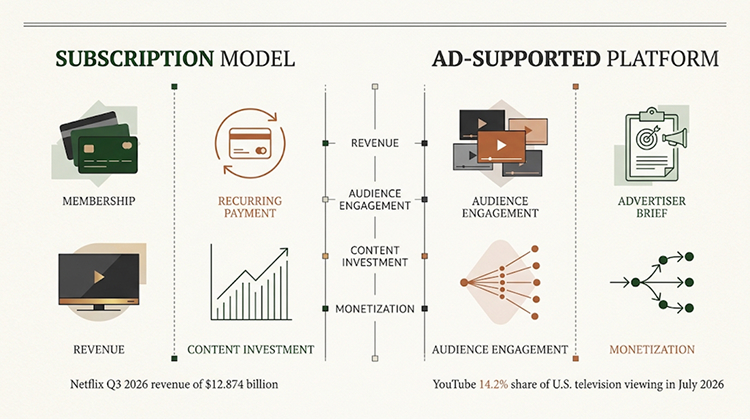
These differences affect how each company approaches content, audience development, and growth.
| Strategic factor | Netflix | YouTube |
|---|---|---|
| Core content model | Premium series, films, licensed content, and live events | Creator videos, podcasts, music, live streams, and professional content |
| Main audience habit | Choosing entertainment to watch | Discovering, following, and exploring content across formats |
| Revenue model | Subscriptions, advertising, and related entertainment initiatives | Advertising, subscriptions, and other platform revenue |
| Content supply | Significant investment in original and licensed programming | Large distributed ecosystem of creators and media partners |
| Discovery strategy | Personalized recommendations within a curated entertainment service | Recommendations across a broad, continually updated content library |
| Main strategic challenge | Sustaining engagement and monetization while controlling content costs | Maintaining viewer attention, creator participation, advertiser confidence, and platform quality |
The table describes the platforms’ general business models rather than a complete account of their financial performance.
For Netflix, a hit series can become a major subscriber acquisition and retention asset. For YouTube, thousands of creators can serve different audiences and interests simultaneously, while new videos continue to appear.
The competitive question is therefore not just which platform has the better content. It is which platform can create the strongest combination of viewing frequency, satisfaction, retention, and monetization.
What Streaming Companies Can Learn From YouTube’s Creator Economy
YouTube’s influence provides lessons for entertainment companies and digital media businesses that want to increase audience engagement.
Create recurring viewing habits
A single successful program may attract a large audience, but recurring formats give people a reason to return.
Streaming companies can apply this principle through weekly shows, live events, companion podcasts, behind-the-scenes content, and regular programming tied to major releases.
Digital publishers can use a similar approach through recurring analysis, daily newsletters, weekly industry roundups, and ongoing coverage of topics that matter to their readers.
The objective is to make a publication or platform part of an audience’s routine rather than relying exclusively on occasional viral hits.
Make content easier to discover
A large content library has limited value if viewers struggle to find material relevant to them.
Netflix and YouTube both rely on recommendations and categorization to help audiences navigate content. Publishers can improve discovery through related articles, topic hubs, internal links, descriptive headlines, and clear category structures.
For example, a website covering streaming business news could connect a report about Netflix’s advertising strategy to related coverage of YouTube creators, connected-TV advertising, and subscription pricing.
That approach creates a more useful experience for readers while giving them additional opportunities to explore the site’s content.
Build multiple formats around important stories
A major entertainment story can support more than one piece of content.
A streaming publisher might develop:
- An initial news report.
- A deeper analysis of the business implications.
- A short video explaining the key figures.
- A newsletter summary with links to related coverage.
- An interview or podcast discussing industry reactions.
This strategy allows publishers to reach different audience preferences without assuming every reader consumes information in the same way.
The formats should complement one another, not simply repeat the same material. Each should offer a clear reason to engage.
Why Advertising and Viewer Attention Matter More Than Ever
Audience attention has commercial value, but viewing time alone does not determine how much money a platform earns.
Advertising revenue depends on several factors, including the number of monetizable impressions, advertiser demand, pricing, audience characteristics, ad formats, and the share of revenue retained by the platform.
Subscription revenue follows a different model, relying on paid memberships, pricing, retention, and the value viewers place on the service.
Netflix’s recent advertising outlook illustrates why adding an ad-supported model does not guarantee that revenue will immediately reach expectations. The company reported that the rollout of some ad capabilities had progressed more slowly than anticipated.
For YouTube, a large viewing share creates opportunities to reach audiences on connected televisions, but the commercial value of that attention depends on how it is monetized and how advertisers evaluate results.
What advertisers should measure
For brands deciding where to invest, the most useful approach is to evaluate a mix of metrics rather than treating viewing time as the only indicator of value.
| Metric | Why it matters |
|---|---|
| Reach | Estimates how many people encounter a campaign |
| Frequency | Shows how often audiences are exposed to the message |
| Viewability and attention | Helps assess whether advertising has a reasonable opportunity to be noticed |
| Completion rate | Measures how often video ads reach their end |
| Brand lift | Evaluates changes in awareness, consideration, or other brand outcomes |
| Conversion rate | Measures the proportion of users completing a desired action |
| Cost per acquisition | Relates campaign spending to acquired customers or leads |
The appropriate combination depends on the campaign’s objectives. A brand building awareness may prioritize reach and frequency, while a performance advertiser may focus more heavily on conversions and acquisition costs.
A platform with a large audience does not automatically deliver the best result for every campaign. Advertisers need to evaluate the audience, the context in which ads appear, and the outcomes they can measure.
What SiteBob and Other Digital Publishers Can Learn
The Netflix–YouTube competition is relevant beyond streaming because it reflects a broader shift in digital media: audience attention is fragmented across platforms, formats, and devices.
Websites, newsletters, podcasts, social platforms, and streaming services all compete for limited time. Publishers that depend on a single discovery channel may become vulnerable when audience behavior changes.
Several practical strategies can help.
1. Focus on audience retention, not just pageviews
A pageview can indicate that content attracted a visitor, but it does not establish whether that person found the experience valuable or will return.
Publishers should track returning users, engaged sessions, newsletter registrations, subscriptions, and other indicators aligned with their business model.
2. Develop recognizable editorial formats
Recurring features help readers understand what a publication offers and why they should return.
SiteBob could use consistent formats for streaming industry analysis, platform business updates, creator economy coverage, and practical digital publishing strategies.
3. Use content clusters to encourage deeper engagement
Related articles should connect through meaningful internal links. A reader who arrives through a story about Netflix’s financial results should be able to discover related analysis of advertising, YouTube’s audience growth, or the economics of subscription streaming.
This improves navigation and gives readers a clearer path through a publication’s coverage.
4. Diversify audience acquisition and revenue
Search engines remain important, but publishers can reduce their reliance on any single source by developing newsletters, direct traffic, social distribution, sponsorships, and other suitable revenue streams.
Diversification does not mean abandoning SEO. It means connecting SEO with a broader system for turning discovery into lasting audience relationships.
Frequently Asked Questions
Is YouTube bigger than Netflix in the United States?
The answer depends on the measurement. Nielsen reported that YouTube accounted for a record 14.2% of total U.S. television viewing in July 2026. Netflix operates a major subscription entertainment business and reported $12.87 billion in third-quarter revenue. Viewing share and company revenue measure different things and should not be treated as interchangeable.
Why is YouTube competing with Netflix?
YouTube offers creator videos, podcasts, live streams, music, commentary, and professional programming, giving it multiple ways to attract viewers. Netflix focuses more heavily on professionally produced entertainment. Both compete for time that audiences could spend watching other services, television, or social video.
How much revenue did Netflix generate in Q3 2026?
Netflix reported revenue of $12.874 billion for the quarter ended September 30, 2026, representing 11.8% year-over-year growth. Its operating margin was 34.6%.
Why is Netflix investing in advertising?
Advertising offers Netflix another way to monetize its audience in addition to subscriptions. However, advertising growth depends on demand from marketers, product capabilities, pricing, and execution. Netflix lowered its 2026 advertising revenue outlook to approximately $2.7 billion in its October 20 shareholder letter.
What can digital publishers learn from Netflix and YouTube?
Publishers can learn to develop recurring content, improve discovery, experiment with multiple formats, measure audience retention, and diversify revenue. The key is to turn an initial visit into a lasting relationship rather than relying exclusively on individual articles or viral moments.
Conclusion: The Future of Streaming Belongs to Platforms That Earn Attention
Netflix and YouTube demonstrate two different approaches to building a video business. Netflix invests in exclusive entertainment and a curated subscription experience. YouTube benefits from a broad creator ecosystem that serves a wide range of viewing habits and interests.
The latest figures show that Netflix remains financially strong, with $12.87 billion in third-quarter 2026 revenue, while YouTube continues to command a substantial share of U.S. television viewing. Neither statistic alone explains the entire competition. Together, however, they show why the streaming industry is increasingly focused on audience behavior, monetization, and retention.
For Netflix, the challenge is to sustain the appeal of premium entertainment while improving advertising performance and maintaining profitable growth. For YouTube, the opportunity is to turn its broad audience and creator ecosystem into continued engagement and monetization.
For digital publishers and media businesses, the lesson is equally clear: content attracts attention, but a sustainable strategy gives people reasons to come back.
As competition across streaming, social video, and digital media intensifies, the strongest businesses will be those that understand their audiences, make discovery easier, measure the outcomes that matter, and build revenue models that reward lasting engagement.